

Act 5, Scene 5 - William Shakespeare - ISC - Std XII
Updated: Sep 2
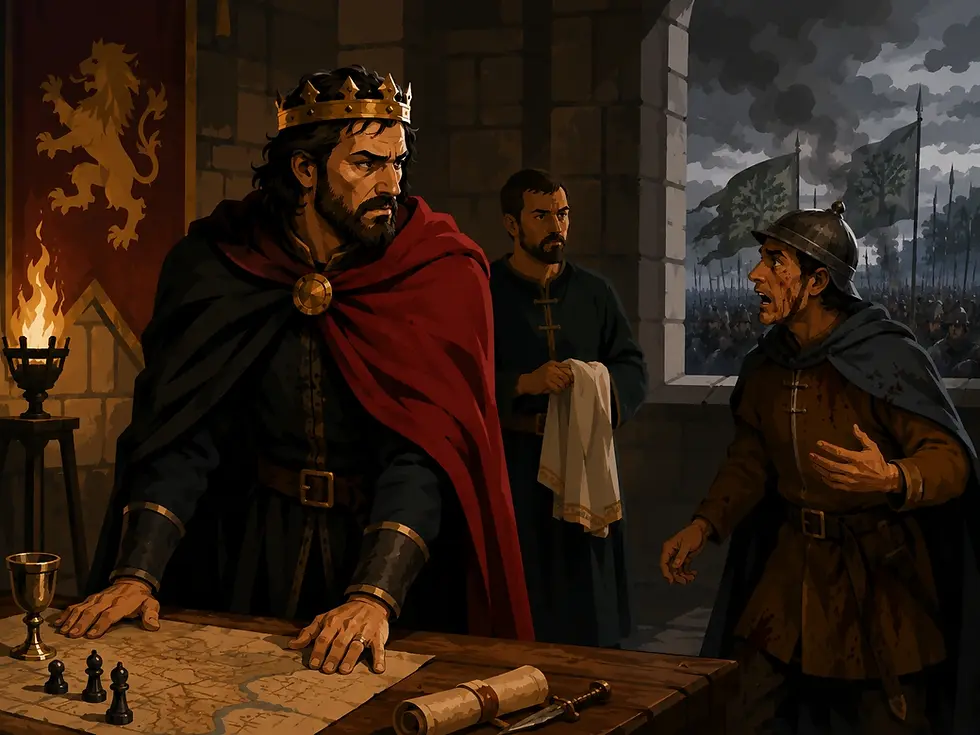
SECTION 1 — Act & Scene Information
Play: Macbeth
Playwright: William Shakespeare
Prescribed Act: Act V
Focus of this Post: Act V, Scene 5 (Inside Dunsinane Castle)
Course: ISC Class 12 Literature in English (CISCE)
Exam Component: Theory Paper, Section B, Drama (20 marks)
SECTION 2 — About the Play & Playwright
William Shakespeare (1564–1616) was an English playwright and poet whose tragedies define the peak of Elizabethan and Jacobean theatre. Composing during an era of significant dynastic realignment under King James I, Shakespeare consistently interrogated the moral duties of sovereign kingship, the spiritual costs of usurpation, and the profound psychological ruin that attends illicit ambition.
Macbeth is a compact, intense tragedy dramatising the psychological and political collapse of a Scottish general driven by ambition, supernatural temptation, and moral self-deception. The drama explores how unchecked power degrades the human conscience, transforming legitimate authority into despotic tyranny and leaving the isolated usurper in existential despair.
SECTION 3 — Scene Map
Section / Event | What Happens |
Fortress Defiance | Macbeth orders banners hung on the outward walls, confident Dunsinane's fortifications will endure a siege until famine and fever destroy the attackers. |
The Cry of Women & Lady Macbeth's Death | A shriek of women interrupts Macbeth; reflecting on his emotional numbness to horrors, he receives Seyton's announcement that the queen is dead. |
The "Tomorrow" Soliloquy | Macbeth delivers his profound meditation on the futility of human existence, comparing life to a brief candle, a walking shadow, a poor player, and an idiot's tale. |
The Moving Grove | A messenger reports that Birnam Wood appears to be moving toward Dunsinane; Macbeth recognizes demonic equivocation and resolves to die fighting in his armour. |
SECTION 4 — Summary
Act V, Scene 5 marks the decisive collapse of Macbeth's supernatural security inside Dunsinane Castle. As the allied forces surround the fortress, Macbeth orders his banners displayed, boasting that his fortifications will withstand any siege until famine and ague consume the enemy. His martial bluster is interrupted by a sudden cry of women; reflecting on his past sensitivity, Macbeth recognizes that repeated atrocities have desensitised him to fear. Seyton then enters to announce that Queen Lady Macbeth is dead. Macbeth responds with the renowned "Tomorrow and tomorrow and tomorrow" soliloquy, expressing a bleak, existential view of human life as an insubstantial, fleeting performance full of sound and fury signifying nothing. This philosophical paralysis is abruptly shattered by a terrified messenger reporting that Birnam Wood appears to be moving toward the castle. Realising that the Weird Sisters have deceived him through equivocal half-truths, and acknowledging that escape or passive defence is impossible, Macbeth casts aside despair to embrace his original warrior identity, ordering the alarum bell rung and resolving to die with harness on his back.
SECTION 5 — Character Notes (This Scene)
Macbeth
Macbeth undergoes an extraordinary emotional transition from hardened bravado to profound philosophical nihilism, culminating in desperate warrior defiance. Having supped full with horrors, he finds himself numbed to fear, yet Lady Macbeth's death prompts an agonizing recognition of life's ultimate futility. When the moving forest exposes the witches' equivocation, he refuses to surrender passively, reclaiming his elemental martial valour to perish in combat.
Seyton
Seyton acts as the dutiful, pragmatic officer who confirms the grim realities of the collapsing regime. His concise, unadorned announcement of the queen's death strips the court of ceremonial dignity, reinforcing the cold isolation and urgency within the besieged castle.
The Messenger
The Messenger embodies truthful reporting under the threat of tyrannical fury. Despite knowing Macbeth's habit of punishing bearers of bad tidings, he stands by his observation of the approaching moving grove, providing the empirical proof that shatters the tyrant's prophetic confidence.
Lady Macbeth (In Death)
Lady Macbeth dies offstage, isolated and broken by suppressed guilt, completing the trajectory of her mental collapse and severing Macbeth's final human relationship.
SECTION 6 — Central Themes
6A. Central Theme
Act V, Scene 5 centres on the catastrophic exposure of supernatural equivocation and the existential despair resulting from a life stripped of moral purpose. Shakespeare dramatises how temporal ambition achieved through bloodshed reduces human existence to an illusion, forcing the usurper to confront the meaninglessness of his stolen power before meeting physical defeat.
6B. Ideas / Concerns / Emotional Movement
The scene examines the psychological cost of habitual violence, the relentless and monotonous passage of time, and the contrast between nihilistic despair and physical bravery. The dramatic movement fluctuates from arrogant defensive bluster to chilling sensory reflection, profound existential melancholy, sudden panic upon the messenger's report, and finally ferocious martial resolve.
SECTION 7 — Vocabulary & Key Techniques
7A. Vocabulary in Context
Word / Phrase | Meaning in this Context | Where It Appears |
Ague | Fever accompanied by acute chills and shivering. | Act V, Scene 5 |
Supped full with horrors | Fed to total saturation on terrifying atrocities, producing emotional numbness. | Act V, Scene 5 |
Direness | Extreme horror, dreadful calamity, or catastrophic dread. | Act V, Scene 5 |
Petty pace | Slow, monotonous, and trivial day-to-day progression. | Act V, Scene 5 |
Dusty death | The physical grave and mortality, recalling biblical dust-to-dust imagery. | Act V, Scene 5 |
Poor player | An insignificant actor who performs briefly and nervously upon a stage. | Act V, Scene 5 |
Equivocation | Deliberately ambiguous phrasing that is literally true but meant to deceive. | Act V, Scene 5 |
Harness | Defensive body armour and military equipment worn by a soldier. | Act V, Scene 5 |
7B. Key Techniques
Theatrical and Metaphorical Conceit: Macbeth compares life to an insubstantial "walking shadow" and a "poor player that struts and frets his hour upon the stage." This meta-theatrical imagery emphasizes the brevity and unreality of temporal authority, framing worldly triumphs as an empty illusion.
Equivocation and Tragic Irony: The apparition's prophecy that Macbeth would not be vanquished until Birnam Wood moved to Dunsinane resolves through human military camouflage. Macbeth finally realizes the demonic nature of the fiend that "lies like truth," experiencing the collapse of his false security.
Sensory Desensitisation: Shakespeare uses gustatory imagery ("supped full with horrors" and the forgotten "taste of fears") to trace Macbeth's moral deadening, illustrating how repeated bloodshed has dulled his emotional capacity to grieve or feel horror.
SECTION 8 — Structured Long-Answer Practice (One Sample Set)
(i) Examine Macbeth's reaction to the cry of women and Seyton's announcement of Lady Macbeth's death in Act V, Scene 5. How does his response illustrate his emotional desensitisation? [5]
"I have supped full with horrors;Direness, familiar to my slaughterous thoughts,Cannot once start me."
Macbeth's reaction to the women's shriek reveals a profound internal metamorphosis produced by habitual violence. Reflecting that a nighttime scream would once have chilled his senses and made his hair stand on end, he acknowledges that his capacity for fear has been extinguished through saturated exposure to atrocities. Having fed upon slaughter, he can no longer be startled by terror. When Seyton delivers the abrupt announcement of the queen's death, Macbeth does not break down in acute grief, but responds with weary resignation, remarking that she should have died hereafter when there was time for mourning. This absence of immediate emotional vulnerability underscores how his bloody pursuit of power has deadened his finest human sensibilities, leaving him emotionally isolated amidst the wreckage of his court.
(ii) Analyze the messenger's report concerning Birnam Wood and Macbeth's subsequent realization of equivocation. How does this moment alter his strategy? [5]
The messenger's astonishing revelation that Birnam Wood appears to be moving toward Dunsinane completely shatters Macbeth's reliance on supernatural guarantees. Although he initially threatens the messenger with execution, the undeniable visual proof of a moving grove forces him to recognize that the Weird Sisters have manipulated him through equivocation—speaking half-truths that are literally fulfilled while masking his actual doom. Realizing that he can neither remain protected within Dunsinane nor escape the encircling armies, Macbeth abandons his passive siege defense. He orders the alarum bell rung and resolves to confront his enemies openly on the battlefield, trading prophetic complacency for desperate martial valor as he chooses to die with armour on his back.
(iii) Answer ONE of the following questions: [10]
(a) Critically evaluate the "Tomorrow and tomorrow and tomorrow" soliloquy in Act V, Scene 5. How does Shakespeare use metaphors of light, theatre, and storytelling to convey Macbeth's existential despair and the tragic waste of his life?
OR
(b) Trace the themes of time, illusion, and warrior courage in Act V, Scene 5. How does this scene balance Macbeth's profound moral guilt with his final tragic dignity?
Model Answer for Option (a):
The "Tomorrow" soliloquy in Act V, Scene 5 represents the philosophical and emotional climax of Macbeth's tragedy, encapsulating the absolute futility of an ambition unanchored from moral value. Sparked by the news of Lady Macbeth's death, Macbeth's meditation moves beyond personal bereavement to confront the crushing monotony of time itself. Through the relentless repetition of "Tomorrow and tomorrow and tomorrow," Shakespeare captures the tedious, creeping rhythm of human existence when stripped of purpose, illustrating that every past day has merely guided humanity toward dusty mortality.
To convey the insubstantial nature of worldly existence, Shakespeare layers three evocative metaphors. First, human life is envisioned as a "brief candle," an easily extinguished flame that recalls Lady Macbeth's desperate taper in the sleepwalking scene. Second, life becomes a "walking shadow" and a "poor player," an anxious actor strutting upon the stage only to vanish into oblivion. This theatrical comparison highlights the artificiality of Macbeth's usurped kingship, exposing his royal reign as a hollow costume worn for a fleeting hour.
Finally, Macbeth reduces human history to a "tale told by an idiot, full of sound and fury, signifying nothing." This bleak conclusion marks the zenith of existential nihilism: all his frantic scheming, bloodshed, and tyrannical striving have amounted to an incoherent story devoid of meaning. The soliloquy poignantly captures the tragic waste of a once-noble hero who, having traded his immortal soul for temporal power, realizes at the edge of the grave that the prize he sacrificed everything for is entirely empty.
SECTION 9 — Personal Response Question
Q. What does Act V, Scene 5 invite you to think, question, or feel about whether facing inescapable defeat with courage can redeem a person who has committed grave moral wrongs? Explain your response with reference to the text.
Act V, Scene 5 evokes a complex mixture of moral condemnation and tragic admiration when confronting Macbeth's final stance against fate. While his bleak nihilism and past atrocities confirm that temporal power gained through murder yields only spiritual barrenness, his refusal to cower behind castle walls when the prophecies collapse restores an undeniable aura of warrior majesty. Watching him shake off existential paralysis to ring the alarum bell and resolve to die with harness on his back does not erase his guilt or pardon his crimes, but it prevents him from descending into pathetic cowardice. The scene invites the reader to recognize that while physical courage cannot undo moral transgressions or grant ethical redemption, an unflinching willingness to face the consequences of one's actions lends a tragic dignity to the end of a ruined life.
CLOSING — Premium Resource Pointer
For students seeking complete examination mastery, our premium ISC Class 12 Macbeth Act V Study Package provides comprehensive coverage of the entire concluding Act. The full PDF edition includes an additional 20-mark structured practice set, exhaustive Section A objective and statement-relationship question banks, extensive cross-Act thematic syntheses, and detailed examiner commentary to maximize performance on the CISCE Literature Theory Paper.


