

The Night Mail - W. H. Auden - ICSE - Std IX
Updated: Sep 4
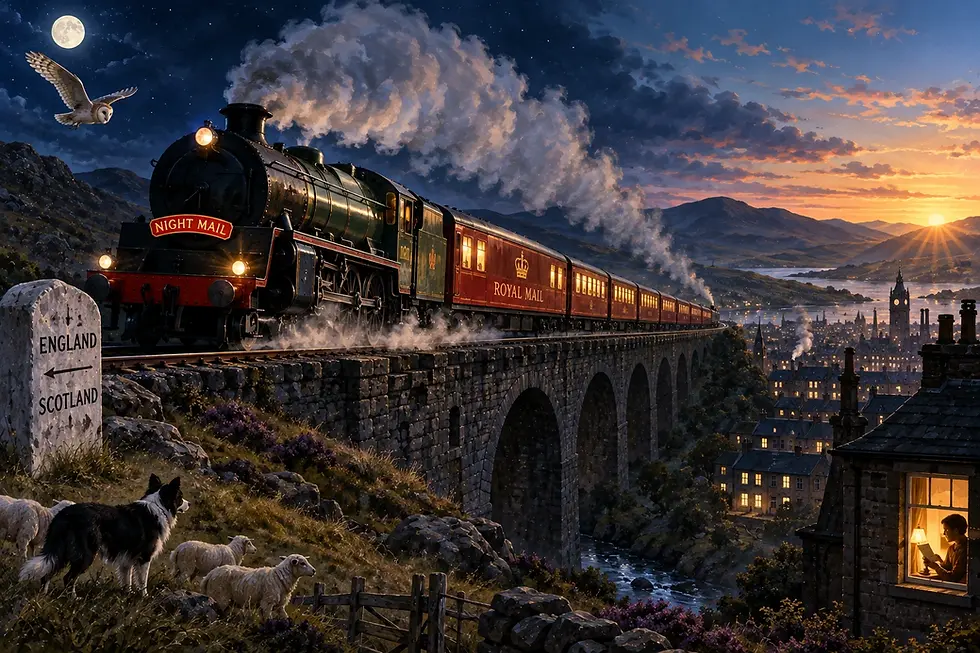
SECTION 1 — Poem Information
Poem Title: The Night Mail
Poet: W. H. Auden
Anthology: Treasure Chest: A Collection of ICSE Short Stories & Poems (Evergreen Publications (India) Ltd., New Delhi)
Textbook: ICSE Class 9 English Literature (CISCE) — prepared against the official CISCE Class IX Literature in English specimen standard
Exam Component: Modelled on the official Class IX specimen's Poetry section (16 marks) — a school-level Class IX assessment standard, not a centrally administered ICSE board paper
SECTION 2 — About the Poet
Wystan Hugh Auden (1907–1973) was an influential Anglo-American poet of the twentieth century, celebrated for his versatile command of rhythm, keen social engagement, and technical precision. Associated with modernist sensibilities and political verse in the 1930s, Auden frequently examined modern culture and community life. Major collections such as Poems (1930) and Another Time established his renown. Written originally for an experimental GPO documentary film in 1936, "The Night Mail" holds a unique place in his body of work by harmonising mechanical railway rhythms with a deeply compassionate portrait of shared human communication.
SECTION 3 — Stanza Map
Stanza # | What It's About (1 line) |
Stanza 1 | The postal express crosses the Scottish border carrying diverse mail for all social strata. |
Stanza 2 | The engine steadily tackles a strenuous upward gradient while strictly maintaining its schedule. |
Stanza 3 | Locomotive steam and mechanical noise animate the silent moorland landscape. |
Stanza 4 | Wild birds and watchful sheep-dogs observe the unstoppable passage of the carriages. |
Stanza 5 | Rural inhabitants remain peacefully asleep beside undisturbed cottages as the train glides past. |
Stanza 6 | Dawn breaks as the train descends toward the expansive industrial structures around Glasgow. |
Stanza 7 | The narrative shifts toward expectant citizens in Scotland awaiting personal and business information. |
Stanza 8 | A rhythmic catalogue showcases correspondence handling celebrations, condolences, financial affairs, and gossip. |
Stanza 9 | Letters of diverse stationery, handwriting, style, and mood reflect the full range of human feeling. |
Stanza 10 | Countless citizens sleep peacefully while the postal carriages continue their solitary overnight journey. |
Stanza 11 | Urban dreamers rest unaware of the continuous physical effort required to deliver their mail. |
Stanza 12 | The anticipated arrival of morning deliveries reveals an innate human desire never to feel forgotten. |
SECTION 4 — Stanza-wise Meaning
Stanza 1
Text Reference: Stanza 1 — beginning with "This is the Night Mail crossing the Border..."
The opening lines introduce the overnight express crossing from England into Scotland with banking instruments and personal post. Auden highlights the complete democratic reach of the service by delivering to both wealthy and impoverished citizens alike. This universal cargo transforms the postal network into a vital societal lifeline that disregards class distinctions.
Stanza 2
Text Reference: Stanza 2 — beginning with "Pulling up Beattock, a steady climb..."
The locomotive tackles a demanding uphill incline through open countryside without falling behind schedule. The journey portrays disciplined persistence, transforming mechanical motion into an embodiment of purposeful determination. Overcoming the physical slope underscores the dependability of modern public infrastructure.
Stanza 3
Text Reference: Stanza 3 — beginning with "Snorting noisily, she passes..."
The locomotive drives through windswept moorlands while trailing white clouds of steam behind it. Sensory descriptions of sound and motion invigorate the barren scenery, contrasting industrial vitality with natural stillness. Auden emphasizes the energetic life force humming within machine-driven transport.
Stanza 4
Text Reference: Stanza 4 — beginning with "Birds turn their heads as she approaches..."
Local wildlife and working farm dogs pause to observe the express train racing along its designated tracks. The animal world acknowledges the locomotive's formidable presence without attempting to disrupt or challenge its progress. Nature thus serves as an attentive spectator to humanity's disciplined transit network.
Stanza 5
Text Reference: Stanza 5 — beginning with "Passes the silent field of the sheep..."
The express journeys past tranquil country pastures and slumbering farmhouses without interrupting local sleep. Although heavy mechanical power shakes domestic teacups slightly, ordinary life remains undisturbed by the train's regular routine. The nocturnal run demonstrates how seamlessly essential services integrate into the rhythm of daily life.
Stanza 6
Text Reference: Stanza 6 — beginning with "Dawn freshens, the climb is done..."
Daylight marks the end of the strenuous ascent as the coaches accelerate downhill into the Scottish lowlands. The poem pivots structurally from natural moorland vistas toward manufacturing centers and looming blast furnaces. This geographic arrival heralds the imminent transition from solitary transport to urban social connection.
Stanza 7
Text Reference: Stanza 7 — beginning with "Towards the fields of apparatus..."
The train approaches major industrial zones where thousands of people reside and await incoming news. The physical landscape of machinery gives way to the emotional landscape of public anticipation and human need. The journey therefore acquires a distinct social purpose by bridging distant communities.
Stanza 8
Text Reference: Stanza 8 — beginning with "Letters of thanks, letters from banks..."
A rapidly pulsing inventory lists diverse types of letters, ranging from professional contracts to private grief and cheerful greetings. The brisk lyrical accumulation demonstrates how commerce, family commitments, and social formalities all depend on the postal vehicle. Every social interaction finds expression inside the train’s mail pouches.
Stanza 9
Text Reference: Stanza 9 — beginning with "Letters with faces scrawled in the margin..."
The catalogue broadens to examine physical handwriting, stationery tints, affectionate margins, and abrupt notes. The chaotic variety of parchment and emotional tones directly mirrors the nuanced complexity of human psychology. Written language serves as an intimate mirror of each individual writer’s mood and personality.
Stanza 10
Text Reference: Stanza 10 — beginning with "In the farm by the telephone..."
The narrative returns to ordinary citizens resting peacefully in private rooms while the express rushes forward. Inhabitants dream their own dreams, completely insulated from the mechanical labour facilitating their morning connectivity. This contrast heightens the silent loyalty of the overnight workers serving society while it rests.
Stanza 11
Text Reference: Stanza 11 — beginning with "Glasgow and Greenock and all the towns..."
Vast manufacturing towns remain immersed in nighttime quiet while the mail delivery approaches. The sleeping population remains entirely unconscious of the vast transit machinery laboring through rain and darkness on their behalf. The continuous voyage demonstrates that communal solidarity often functions without fanfare.
Stanza 12
Text Reference: Stanza 12 — beginning with "None will hear the postman’s knock..."
The final lines highlight the anxious hope experienced when morning mail is pushed through the doorway. Receiving personal written mail assures individuals that someone across distant miles values their existence and remembers them. The entire transit system ultimately serves to relieve human loneliness and affirm mutual affection.
SECTION 5 — Central Theme and Mood
5A. Theme
The poem illustrates how communication connects separated individuals across geographical, economic, and social boundaries. Auden presents the postal train as an essential societal lifeline that converts mechanical movement into reliable human fellowship and emotional affirmation.
5B. Tone / Emotional Movement
The poem opens with brisk mechanical momentum and purposeful energy, mirroring the rhythmic chugging of an engine on the tracks. As dawn breaks over urban centers, the emotional tone deepens into reflective warmth and profound empathy, climaxing in the shared vulnerability of the line: "For who can bear to feel himself forgotten?"
5C. Key Ideas
The postal network functions as a democratic equalising force by carrying documents for all walks of life with equal punctuality. Furthermore, invisible labour sustains community life, functioning reliably while the larger populace sleeps peacefully.
SECTION 6 — Vocabulary in Context
Word/Phrase | Meaning IN THIS CONTEXT | Line/Stanza Reference |
Postal order | A government-backed financial instrument purchased at a post office to remit money securely by post. | Stanza 1 |
Gradient | The degree of incline or steepness of the railway track up the hill. | Stanza 2 |
Moorland | Tracts of open, uncultivated highland terrain covered with rough grasses and heather. | Stanza 3 |
Boulder | A large, weather-worn rock sitting beside the upland railway path. | Stanza 3 |
Blank-faced | Smooth, featureless coach surfaces devoid of human expression or warmth. | Stanza 4 |
Apparatus | The collective mechanical cranes, chimneys, and equipment of heavy industry. | Stanza 7 |
Condolence | Formal expressions of sympathy forwarded to someone suffering bereavement. | Stanza 8 |
Heart outpouring | An unrestrained, deeply emotional confession of passionate affection or distress. | Stanza 9 |
Quickening | A sudden acceleration of the heartbeat sparked by nervous anticipation. | Stanza 12 |
SECTION 7 — Poetic Devices
Device | Exact Quoted Phrase or Line | Effect | Stanza # |
Personification | "The gradient's against her, but she's on time" | Portrays the locomotive as a determined female traveler, emphasizing persistence, duty, and humanized effort against physical obstacles. | Stanza 2 |
Onomatopoeia | "Snorting noisily" | Evokes the rhythmic, percussive blast of steam venting from the engine, mimicking animal vitality and mechanical force. | Stanza 3 |
Simile | "like gigantic chessmen" | Compares towering industrial furnaces and structures to playing pieces, framing modern manufacturing as an organized, colossal game. | Stanza 6 |
Repetition | "Letters of thanks, letters from banks" | Emphasizes the massive volume, endless diversity, and all-encompassing nature of human messages flowing across the country. | Stanza 8 |
Rhyme Scheme: Structured predominantly in rhythmic rhyming couplets in early sections, transitioning flexibly into varied, rapid-fire rhythmic meters to mirror the accelerating and decelerating speeds of the locomotive.
SECTION 8 — Extract Practice (One Sample Set)
Passage Reference: Stanza 1 — beginning with "This is the Night Mail crossing the Border..." Read the complete stanza in the prescribed textbook before answering.
(i) What items does the Night Mail transport, and what does its cargo reveal about its societal function? [3]
Mailbags on the express contain bank cheques, postal orders, and letters addressed to citizens across all social ranks. The simultaneous carriage of financial instruments and personal messages shows that the train services both economic industry and intimate domestic relationships. By serving both rich and poor with equal diligence, the postal service functions as a universal social equalizer.
(ii) Why is the punctuality of the train emphasized right at the beginning of its journey? [3]
Punctuality establishes the mail train as a model of discipline and unfailing reliability amidst challenging nocturnal conditions. Strict timing is necessary because economic transactions, legal notices, and anxious relatives rely upon the dependable arrival of morning post. Maintaining its schedule despite geographic obstacles reinforces the locomotive's role as a trustworthy public institution.
(iii) What does the phrase "crossing the Border" signify within the wider context of the poem? [3]
Crossing the border refers geographically to the passage from England into Scotland during the night. Metaphorically, the journey indicates the railway's capacity to transcend regional separations and join distant communities into a unified whole. Communication erases political and natural divisions by weaving dispersed lives together.
(iv) How does Auden establish the rhythmic tempo of the train in this opening section? [3]
Auden employs a regular, driving meter that replicates the percussive clatter of train wheels over rail joints. Rhyming couplets create an orderly, relentless momentum that pulls the reader along the route. Sound patterns in the verse reinforce the visual impression of an unstoppable engine forging ahead.
(v) How does this introductory passage prepare the reader for the central emotional concern developed at the end of the poem? [4]
Auden introduces the postal service as a vast public operation but deliberately includes personal correspondence alongside impersonal bank notes. This early blending of commercial duty and human feeling shows that letters represent genuine personal ties rather than ordinary bundles of paper. By showing the train crossing desolate borders to reach disparate people, the opening grounds the technical delivery system in community welfare. Consequently, the initial public journey leads naturally to the final stanza's revelation that receiving mail validates individual human identity.
SECTION 9 — Short Answer Questions
Q1. Explain the central theme of "The Night Mail" in your own words.
Auden explores how structured public communication bridges isolation and strengthens the emotional bonds of a nation. The journey of the night train unites urban centers with rural outposts, ensuring that economic activity and personal sentiments continue uninterrupted. By treating business letters and emotional outpourings with identical care, the poem shows that human relationships depend on dependable channels of contact. The ultimate significance of the journey lies in reassuring isolated individuals that they are loved, remembered, and integrated into a broader community.
Q2. How does the poem encourage the reader to reflect on the value of written correspondence in an era of rapid technological change?
Auden's vivid depiction of personal handwriting, physical paper, and the suspenseful morning postal knock highlights the tactile, thoughtful nature of written communication. In an age dominated by instantaneous, transient digital messages, the poem reminds readers of the deliberate care invested in composing physical letters. The emotional tension surrounding the arrival of news demonstrates that the fundamental human fear of being forgotten remains timeless. Ultimately, the work invites readers to appreciate the patient human effort and dedication that sustain personal relationships across physical distance.
CLOSING — Premium Resource Pointer
To deepen your study beyond this introductory blog post, consult the full BhashaLab PDF Notes for "The Night Mail." The complete study guide offers comprehensive exam preparation, featuring multiple extract practice sets with complete marking schemes, an objective-question practice bank, and targeted guidance for avoiding common examiner-noted pitfalls.


