

1.2. Bharat Our Land - Class 9 - Kaveri
- May 27
- 9 min read
Updated: May 29
SECTION 1: CHAPTER OVERVIEW
Category | Details |
Chapter / Poem Title | Bharat Our Land |
Author / Poet | Subramania Bharati |
Textbook | Kaveri — Textbook of English for Grade 9 (NCERT, First Edition) |
Chapter Type | Poetry |
Text Type | Lyric / Ode |
Unit Theme | Patriotism, Cultural Heritage, and National Pride |
Companion Text | How I Taught My Grandmother to Read by Sudha Murty |
Reference Document | 6.1.pdf |
SECTION 2: STANZA-WISE OVERVIEW
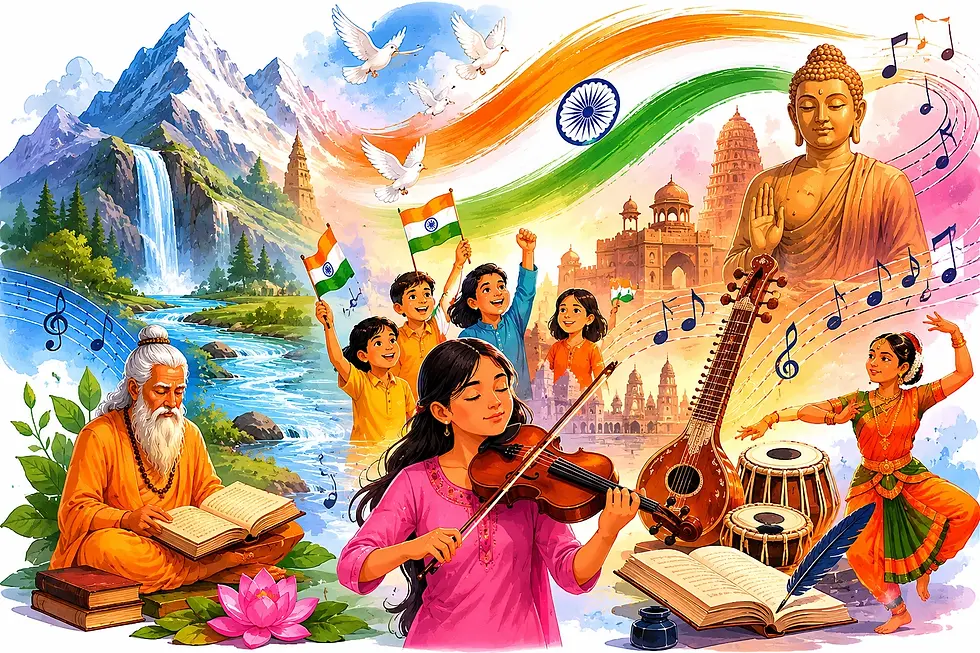
Stanza 1: "The mighty Himavant is ours—"
Literal Meaning: The stanza asserts that India possesses the massive Himalayan mountains, the giving and elegant Ganges river, the sacred and wise text of the Upanishads, and a radiant, golden landscape that is unmatched across the globe.
Inference/Implication: The poet implies that India's physical geography is intrinsically linked to its spiritual identity, presenting nature not merely as scenery but as a living monument of divine grace and unparalleled national exceptionalism.
Stanza 2: "Gallant warriors have lived here,"
Literal Meaning: This stanza declares that India is a land sanctified by brave soldiers, pure sages, divine music, auspicious events, sacred ultimate knowledge (Brahma-knowledge), and the moral teachings of Gautama Buddha.
Inference/Implication: The poet suggests that true national greatness relies on a harmonious synthesis of temporal strength and spiritual enlightenment, balancing the courage of the warrior with the peaceful, compassionate wisdom of the philosopher.
SECTION 4: LITERARY DEVICES [POETRY ONLY]
Device | Example from Text | Effect |
Personification | "she's peerless, let's praise her!" | Gives the nation of Bharat the human qualities of a revered, unmatched mother figure worthy of absolute devotion. |
Rhetorical Question | "which other river can match her grace?" | Forces the reader to actively agree that the Ganga's beauty and life-giving generosity are globally unmatched. |
Hyperbole | "there's no equal anywhere on earth." | Uses extreme exaggeration to emphasize the absolute supremacy and majesty of the Himalayan mountains. |
Allusion | "the Buddha preached his dhamma here." | Indirectly references the historical and religious significance of Gautama Buddha's teachings of compassion and enlightenment. |
Metaphor | "This sunny golden land is ours" | Compares the nation to a bright, golden entity, symbolizing its inherent wealth, warmth, and enduring glory. |
Repetition | "she's peerless, let's praise her!" | Continually reinforces the poem's central message of absolute national devotion and collective admiration. |
Anaphora | "The mighty... / The generous... / The sacred..." | Creates a rhythmic, chanting quality that builds a powerful, overwhelming list of the nation's greatest assets. |
Imagery | "sunny golden land" | Appeals to the visual sense, creating a radiant, optimistic mental picture of India's physical beauty and prosperity. |
SECTION 5: CENTRAL THEME, UNIT THEME & VALUES
5A. Themes Table
Theme | Explanation in Context |
Patriotism and National Pride (Unit Theme) | The text celebrates the unparalleled greatness of India's geography, ancient history, and profound spiritual legacy. |
Cultural Heritage | The poem honors the ancient wisdom embedded in texts like the Upanishads and the enlightened teachings of the Buddha. |
Spiritual Supremacy | The narrative highlights that India is not just a landmass, but a holy space sanctified by sages and rooted deeply in "Brahma-knowledge." |
Unity and Ownership | The repeated, forceful use of the word "ours" fosters a strong, collective sense of belonging and shared national identity among readers. |
5B. Human Values
National Pride: Illustrated when the poet repeatedly proclaims the unique assets of the motherland and demands that "she's peerless, let's praise her!"
Environmental Responsibility: Evoked through the deep reverence for the grace of the Ganga and the might of the Himavant, teaching readers to treat nature as sacred.
Compassion: Demonstrated through the explicit textual invocation of the Buddha's Dhamma, which emphasizes universal empathy and non-violence.
Respect for Wisdom: Highlighted by the celebration of the Upanishads and sages who purified the land through lifelong intellectual and spiritual pursuits.
SECTION 6: POEM TITLE JUSTIFICATION
The title "Bharat Our Land" uses the collective pronoun "Our" to foster an immediate sense of shared ownership and unity among citizens. It establishes a patriotic framework, framing the physical territory of Bharat not merely as a piece of earth, but as an extraordinary repository of shared history, sacred nature, and spiritual enlightenment.
SECTION 7: UNIT CROSS-TEXT CONNECTION
Companion Text: To be specified based on the individual NCERT workbook pairing.
Theme Synthesis: Both texts explore the complex layers of Indian civilization by analyzing how historical roots inform modern consciousness. They look at how cultural legacy shapes our understanding of duty, home, and identity.
Key Contrast: The prose selection analyzes cultural evolution through an analytical or narrative lens, whereas the poem relies on elevated, emotional symbolism and rhythmic adoration to celebrate the nation.
Exam Question: "How does the analytical perspective in the companion text echo or contrast with the emotional and spiritual adoration of the homeland presented in 'Bharat Our Land'?"
SECTION 8: REFERENCE TO CONTEXT (EXTRACT QUESTIONS)
Extract 1
"The mighty Himavant is ours— there's no equal anywhere on earth. The generous Ganga is ours— which other river can match her grace?"
Q1. Which of the following best describes the function of the word "mighty" in the first line? (A) To indicate the literal height and weight of the mountain range. (B) To emphasize the physical grandeur and symbolic strength of the Himavant. (C) To suggest that the mountain is unyielding and dangerous to scale. (D) To contrast the mountain with the low-lying plains of the country. Answer: (B) — The word highlights both physical majesty and the symbolic protection the mountains offer the nation.
Q2. What literary device is predominantly featured in the description of the Ganga? (A) Oxymoron (B) Personification (C) Hyperbole (D) Foregrounding Answer: (B) — The river is personified through the attributes of generosity and grace, treating her as a living benefactor.
Q3. What does the rhetorical question "which other river can match her grace?" suggest about the poet's intent? Answer: Subramania Bharati uses this rhetorical question to challenge the reader to find an equal, thereby reinforcing the incomparable spiritual and aesthetic value of India's natural resources.
Q4. How do these lines connect to the overarching theme of the unit? Answer: These lines establish a profound sense of national identity by converting geographical features into shared cultural monuments that evoke collective pride and reverence.
Extract 2
"Here Brahma-knowledge has taken root, and the Buddha preached his dhamma here. Of hoary antiquity is Bharat, she's peerless, let's praise her!"
Q1. What does the phrase "hoary antiquity" tell us about Bharat? (A) It is a young nation with a bright future. (B) It is a land with an incredibly ancient and revered history. (C) It is a nation frozen in time and unable to modernize. (D) It is a territory whose history has been largely forgotten. Answer: (B) — "Hoary" means grey or white with age, signifying an ancient history that commands deep respect.
Q2. The inclusion of "Brahma-knowledge" and "Buddha's dhamma" serves as an example of: (A) Literary Allusion (B) Visual Imagery (C) Paradoxical Contrast (D) Onomatopoeia Answer: (A) — The poet references specific historical and philosophical traditions to ground the country's greatness in spiritual reality.
Q3. What does the metaphor "taken root" suggest about spiritual wisdom in India? Answer: The phrase suggests that philosophical wisdom is not an imported concept but is permanently anchored, growing naturally within the very fabric of Indian society.
Q4. How does the final refrain reinforce the structural message of the poem? Answer: The refrain acts as an emotional resolution, transforming historical and spiritual evidence into a direct call to action for citizens to recognize and honor their homeland's unique status.
SECTION 9: SHORT ANSWER QUESTIONS
Q1. What is the poet's underlying intent behind referencing the Upanishads alongside the Himavant? Answer: Subramania Bharati intends to demonstrate that India's intellectual and spiritual achievements are just as grand, permanent, and monumental as its physical geography, balancing material reality with philosophical depth.
Q2. Explain the significance of the hyphen used in the line "The mighty Himavant is ours—". Answer: The hyphen creates a deliberate poetic pause that allows the reader to absorb the statement of ownership before encountering the absolute hyperbole that asserts the mountain's global supremacy.
Q3. What does the presence of both "gallant warriors" and "sages" reveal about ancient Indian society? Answer: This combination reveals a balanced civilization that values physical bravery and protective security just as much as it values moral purification, ethical reflection, and intellectual pursuits.
Q4. How does the description of the Ganga as "generous" connect to human values? Answer: The description highlights the value of selfless giving and environmental responsibility, prompting citizens to appreciate how nature sustains human life without asking for anything in return.
Q5. Identify the literary device in "divinest music" and explain its effect on the tone of the poem. Answer: The poet uses a superlative adjective as a form of hyperbole, which elevates the tone to a state of ecstatic devotion and absolute reverence for the country's cultural arts.
Q6. Compare how the poet establishes physical greatness versus spiritual greatness in the first stanza. Answer: Subramania Bharati establishes physical greatness by highlighting external landmarks like the towering Himavant and the graceful Ganga, while spiritual greatness is established internally through the unparalleled wisdom of the sacred Upanishads.
SECTION 10: LONG ANSWER QUESTIONS
Q1. The teachings of the Buddha and the concept of Brahma-knowledge highlight a profound legacy of intellectual and ethical growth. How does "Bharat Our Land" extrapolate beyond mere patriotism to advocate for universal human values? Answer: Subramania Bharati constructs a vision of patriotism that is deeply rooted in ethical enlightenment rather than aggressive nationalism. By highlighting "Brahma-knowledge" and "Buddha's dhamma," the text focuses on self-realization, compassion, and non-violence as the core pillars of the Indian identity. The poem goes beyond simple geographic pride by showing that a nation’s true value lies in its historical role as a global teacher of moral truth. Therefore, the text inspires readers to cultivate internal virtues like justice, empathy, and intellectual curiosity. It reminds us that honoring one's land means preserving its legacy of peace and philosophical depth.
Q2. Imagine a dialogue where a modern student questions the relevance of "hoary antiquity" in an era dominated by technology and globalization. Based on your reading of the poem, how would the speaker of "Bharat Our Land" validate the importance of ancient heritage today? Answer: The speaker of the poem would argue that ancient heritage acts as an essential moral compass in a rapidly changing digital world. Instead of viewing history as obsolete, the speaker would present the "sacred Upanishads" and the teachings of sages as timeless frameworks for ethical living. Textual evidence indicates that India's ancient identity was built on a balanced combination of courage and deep philosophical thought. The speaker would explain that technology provides speed, but heritage provides the direction and wisdom needed to use that power responsibly. Ultimately, the speaker would show that remembering our deep roots ensures that progress does not lead to a loss of identity.
SECTION 11: COMPETENCY-BASED ASSESSMENT
11A. Assertion & Reasoning
Q1. Assertion (A): The poet describes the Ganga as possessing a "grace" that no other river can match. Reason (R): The text seeks to foster an attitude of absolute adoration and national pride by presenting India's geography as unmatched. Answer: (A) — The unique grace attributed to the river serves as poetic evidence to support the central assertion of national supremacy.
Q2. Assertion (A): The poem "Bharat Our Land" can be classified structurally as an ode.
Reason (R): The poem relies on informal, conversational language to critque historical events and societal issues. Answer: (C) — The assertion is true because the text is an elevated song of praise, but the reason is false since the language is grand, formal, and celebratory.
Q3. Assertion (A): Subramania Bharati mentions both warriors and sages within the exact same stanza. Reason (R): The poet implies that a great civilization requires a balance between physical defense and spiritual wisdom. Answer: (A) — The juxtaposition of these two figures directly explains the poet's holistic view of national excellence.
11B. HOTS — Real-World Connection
Scenario 1
A Class 9 student feels overwhelmed by global trends on social media and starts to believe that their own local traditions, regional languages, and cultural history are old-fashioned and irrelevant.
Question
How does the poet's response to India's "hoary antiquity" connect to this modern student's dilemma? Answer: Subramania Bharati addresses this insecurity by reframing ancient roots as a unique badge of honor rather than an outdated burden. The poem shows that landmarks like the Upanishads and the Himavant offer a timeless sense of security and identity that modern internet trends cannot replicate. By realizing that their heritage is built on timeless values like compassion and deep wisdom, the student can develop a healthy sense of self-worth. This understanding helps them navigate global spaces with confidence instead of feeling inferior.
Scenario 2
During a school project on environmental preservation, a group of students argues that natural resources should be managed strictly based on economic value and industrial utility.
Question
How does the depiction of nature in "Bharat Our Land" challenge or enrich this modern economic viewpoint? Answer: The poem directly challenges a purely commercial view of nature by describing the Ganga as "generous" and full of "grace," elevating it to a sacred entity. This poetic perspective teaches students that nature has intrinsic spiritual and aesthetic value that goes far beyond simple economic utility. By viewing the land as an irreplaceable part of our shared identity, students are encouraged to protect the environment out of genuine reverence rather than mere financial necessity.
About BhashaLab
BhashaLab is a dynamic platform dedicated to the exploration and mastery of languages - operating both online and offline. Aligned with the National Education Policy (NEP) 2020 and the National Credit Framework (NCrF), we offer language education that emphasizes measurable learning outcomes and recognized, transferable credits.
We offer:
1. NEP alligned offline language courses for degree colleges - English, Sanskrit, Marathi and Hindi
2. NEP alligned offline language courses for schools - English, Sanskrit, Marathi and Hindi
3. Std VIII, IX and X - English and Sanskrit Curriculum Tuitions - All boards
4. International English Olympiad Tuitions - All classes
5. Basic and Advanced English Grammar - Offline and Online - Class 3 and above
6. English Communication Skills for working professionals, adults and students - Offline and Online
Contact: +91 86577 20901, +91 97021 12044
Mail: info@bhashalab.com
Website: www.bhashalab.com


Comments