

1.2. On to the Summit: We Reach the Top - Class 11 -English Yuvakbharati
- Mar 11
- 5 min read
Updated: Mar 25
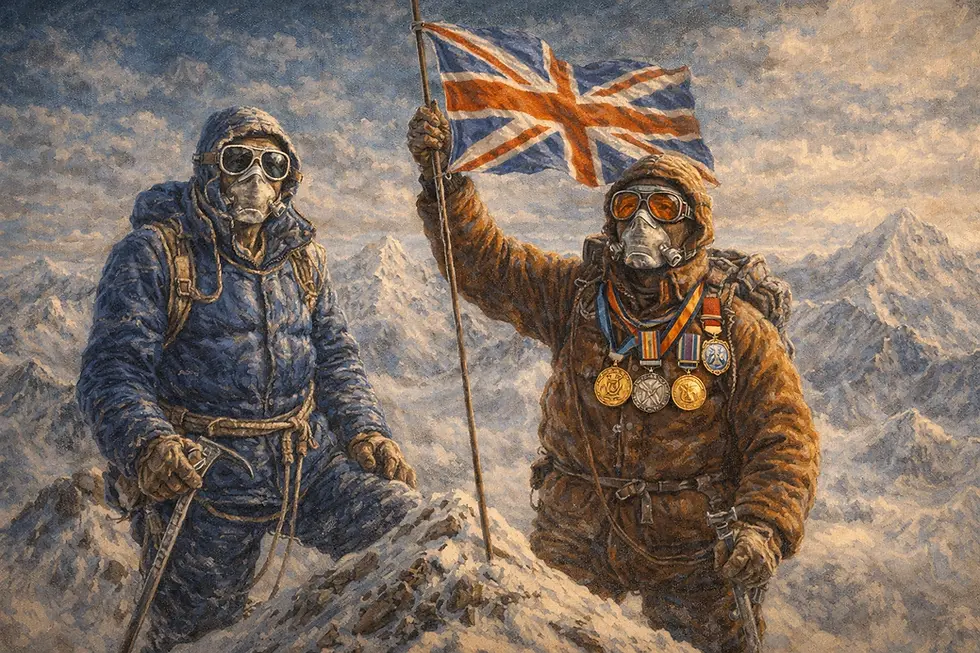
Author: Tenzing Norgay | Genre: Prose (Non-fiction/Autobiography)
1. Comprehensive Glossary
Word | Meaning (English) | Meaning (Hindi) |
Summit | The highest point of a hill or mountain | शिखर / चोटी |
Expedition | A journey undertaken by a group of people with a particular purpose | अभियान |
Prerequisites | Things that are required as a prior condition | पूर्वापेक्षाएँ / आवश्यक शर्तें |
Hazards | Dangers or risks | खतरे |
Anecdotes | Short and amusing or interesting stories about a real incident or person | किस्से / लघुकथाएँ |
Accomplishments | Achievements or successful completions of tasks | उपलब्धियाँ |
Rappelling | Descending a rock face or other near-vertical surface by using a doubled rope coiled round the body | रस्सी के सहारे नीचे उतरना |
Struggle | Make forceful efforts to get free of restraint or constriction | संघर्ष |
Historic | Famous or important in history | ऐतिहासिक |
Honoured | Regarded with great respect | सम्मानित |
2. Introduction & Summary
Ice Breakers:
Discuss with your partner the various activities related to climbing, such as rappelling and rock climbing.
What are the mental and physical fitness requirements for mountaineering? Discuss the necessary training and equipment needed for a successful expedition.
Summary: This extract features Tenzing Norgay, one of the first two individuals to reach the summit of Mount Everest, describing the historic climb accomplished with Edmund Hillary on May 29, 1953. Tenzing, a Nepali-Indian Sherpa mountaineer, provides a first-hand account of the events that occurred during this monumental achievement.
The text details the honors Tenzing received for his career, including the Tiger Medal from the Himalayan Club in 1938, the Star of Nepal in 1953, and the Padma Bhushan from the Government of India in 1959. Beyond the technical aspects of the climb, the narrative focuses on the struggles, failures, and messages derived from the lives of successful mountaineers.
3. HSC Board Activity Sheet Pattern (Prose Section)
A1. Global Understanding (2 Marks)
Set 1: True or False
Tenzing Norgay reached the summit of Mt. Everest alone. (False)
Edmund Hillary accompanied Tenzing Norgay on the historic climb. (True)
Tenzing Norgay was honored with the Padma Bhushan in 1959. (True)
Mountaineering does not require any physical or mental fitness. (False)
Tenzing Norgay was a Sherpa mountaineer. (True)
Set 2: Matching Honors
Question: Match the Honor with the Year/Source.
Honors: 1. Tiger Medal, 2. Star of Nepal, 3. Padma Bhushan.
Source/Year: a. King Tribhuvan (1953), b. Govt. of India (1959), c. Himalayan Club (1938).
Answer: 1-c, 2-a, 3-b.
Set 3: Complete the Web
Question: Identify the prerequisites for Mountaineering mentioned in the Ice Breakers.
Answer: 1. Time, 2. Training, 3. Equipment, 4. Mental and physical fitness.
Set 4: Sequence of Events
Tenzing Norgay receives the Star of Nepal.
Tenzing Norgay receives the Tiger Medal.
Tenzing Norgay reaches the summit of Mt. Everest.
Tenzing Norgay is awarded the Padma Bhushan.
Answer: 2 → 3 → 1 → 4.
Set 5: Identification
The specific date the summit was reached: May 29, 1953.
The club that awarded the Tiger Medal: Himalayan Club.
A2. Complex Factual (2 Marks)
Question: What honors were bestowed upon Tenzing Norgay for his mountaineering achievements?
Answer: Tenzing Norgay received the Tiger Medal from the Himalayan Club in 1938 for the III Everest Expedition, the Star of Nepal in 1953 from King Tribhuvan for all his accomplishments, and the Padma Bhushan in 1959 from the Government of India.
Question: Explain the significance of May 29, 1953, in the context of the extract.
Answer: This date marks the historic accomplishment when Tenzing Norgay and Edmund Hillary became the first two individuals known to successfully reach the summit of Mount Everest.
Question: List the climbing activities and hazards discussed in the Ice Breakers.
Answer: Climbing activities include rappelling and rock climbing. Hazards and risks mentioned include those faced by mountaineers and trekkers during a dangerous expedition.
Question: What are the key prerequisites for mountaineering according to the text?
Answer: Mountaineering requires adequate time, specialized training, proper equipment, appropriate clothes, and both mental and physical fitness to handle the distance and risks
Question: How does the text categorize the adjectives used for comparison?
Answer: The text demonstrates the three forms of comparison: positive (as bright as), comparative (brighter than/newer than), and superlative (the brightest/the tallest/the most wonderful).
A3. Inference / Interpretation / Analysis (2 Marks)
Question: "Mountaineering is more than just a physical activity." Interpret this based on the Ice Breakers.
Answer: The text emphasizes "Mental and physical fitness" and "training" as prerequisites. This implies that while strength is needed, the mental resilience to face hazards and the knowledge to use specialized equipment are equally vital.
Question: Analyze the importance of Tenzing Norgay's "Tiger Medal" in his career.
Answer: Awarded in 1938 for the III Everest Expedition, this early honor from the Himalayan Club shows that Tenzing was already a distinguished mountaineer long before his historic 1953 climb.
Question: Why does the text suggest studying the "struggles and failures" of famous mountaineers?
Answer: Understanding struggles and failures provides a realistic view of mountaineering. It offers valuable lessons and messages about perseverance that can inspire others, rather than just focusing on the final success.
Question: Interpret the significance of the "Star of Nepal" being awarded for "All accomplishments."
Answer: Unlike specific medals for one expedition, this award from King Tribhuvan in 1953 recognizes Tenzing's entire career and his role as a national hero following the Everest summit.
Question: How does the grammar section on adjectives relate to the theme of mountaineering?
Answer: Just as mountains have different heights (high, higher, highest), adjectives help describe the varying intensities of the climbing experience, the quality of equipment, and the magnitude of the achievements.
A4. Personal Response (2 Marks)
Question: Would you like to go on a mountaineering expedition? Why or why not?
Answer: (Personal Answer Example): Yes, I would love to, because I enjoy physical challenges and the thrill of exploring nature. However, I realize that it requires rigorous training and mental preparation to handle the risks mentioned in the text.
Question: What "message" do you get from the life of a person like Tenzing Norgay?
Answer: His life teaches that with persistence and dedication, one can reach the "top" of any field. His journey from an early medal in 1938 to global fame in 1953 shows that success is built over many years of hard work.
Question: Do you think mental fitness is more important than physical fitness in dangerous sports?
Answer: In my opinion, both are essential. While physical fitness allows you to perform, mental fitness gives you the courage to make decisions under pressure and the strength to not give up when facing hazards like those in mountaineering.
Question: If you had to choose a "career goal" in adventure sports, what would it be?
Answer: (Personal Answer Example): I would aim to be a professional trekker or a mountain guide. This would allow me to apply the qualities of leadership and empathy while navigating the technical challenges of the terrain.
Question: How do you handle failure in your life?
Answer: I believe that failure is a learning opportunity. Just as mountaineers face failures before reaching the summit, I try to analyze my mistakes and use them as stepping stones to eventually reach my own goals.
About BhashaLab
BhashaLab is a dynamic platform dedicated to the exploration and mastery of languages - operating both online and offline. Aligned with the National Education Policy (NEP) 2020 and the National Credit Framework (NCrF), we offer language education that emphasizes measurable learning outcomes and recognized, transferable credits.
We offer:
NEP alligned offline language courses for degree colleges - English, Sanskrit, Marathi and Hindi
NEP alligned offline language courses for schools - English, Sanskrit, Marathi and Hindi
Std VIII, IX and X - English and Sanskrit Curriculum Tuitions - All boards
International English Olympiad Tuitions - All classes
Basic and Advanced English Grammar - Offline and Online - Class 3 and above
English Communication Skills for working professionals, adults and students - Offline and Online
Contact: +91 86577 20901, +91 97021 12044
Mail: info@bhashalab.com
Website: www.bhashalab.com


Comments