

3.4. Let's March! - Std X - Mah Board - My English Coursebook - Semi English and Marathi Medium
Updated: Jun 22
SECTION 1 — Chapter Information / पाठ परिचय
Feature | Details |
Chapter | Unit 3 — Chapter 3.4: Let's March! |
Type | Informative Prose (Speech) |
Author | Kailash Satyarthi |
Textbook | My English Coursebook, Std X, Maharashtra State Board |
Board Section | Section II — Reading Skills (Textual) — 20 marks |
मराठी टीप: हा पाठ परीक्षेत Reading Skills Textual विभागात येतो — एकूण 20 गुण.
SECTION 2 — About the Author / लेखक परिचय
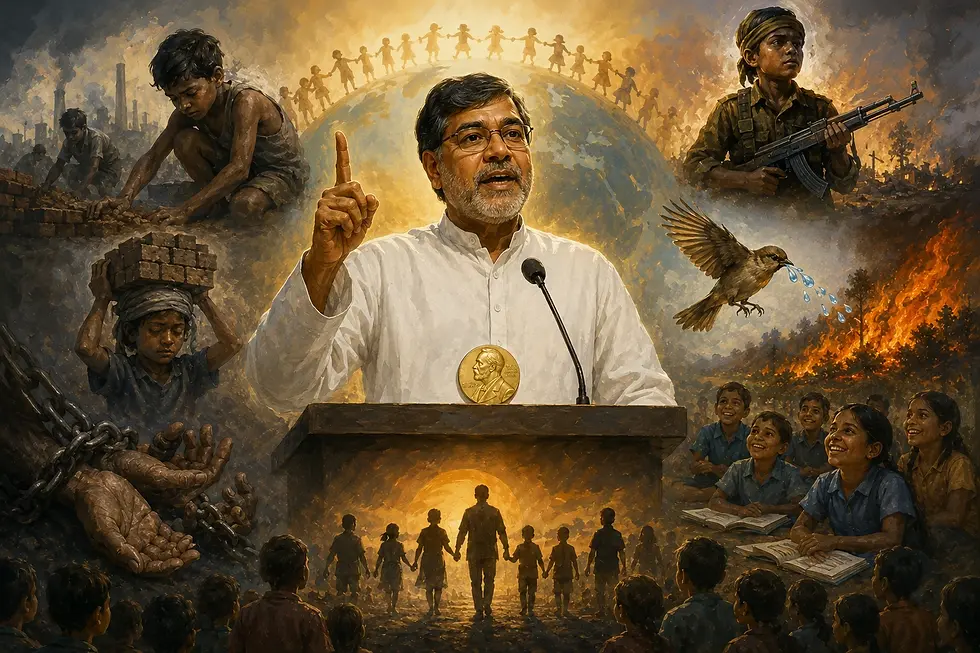
Kailash Satyarthi is a renowned Indian social reformer and children's rights activist who has campaigned extensively against child labour globally. Born in India, he founded the 'Bachpan Bachao Andolan' (Save the Childhood Movement) and has rescued thousands of children from slavery, trafficking, and exploitative labour. In 2014, he was awarded the Nobel Peace Prize jointly with Malala Yousafzai. "Let's March!" is his Nobel Acceptance Speech, wherein he passionately advocates for the rights, freedom, and education of every child in the world, urging global citizens to take immediate action.
मराठी टीप: कैलास सत्यार्थी हे एक प्रसिद्ध भारतीय समाजसुधारक आणि बालहक्क कार्यकर्ते आहेत. त्यांनी 'बचपन बचाओ आंदोलन' सुरू केले आणि हजारो बालमजुरांची सुटका केली. २०१४ मध्ये त्यांना नोबेल शांतता पुरस्कार मिळाला. हे भाषण त्यांनी तो पुरस्कार स्वीकारताना दिले आहे.
SECTION 4 — Summary / सारांश
Kailash Satyarthi begins his Nobel Acceptance Speech by expressing his deep honour to represent the marginalized, silenced, and enslaved children of the world . He dedicates the award to the martyrs and activists who sacrificed their lives for child rights . Satyarthi vividly describes the horrors faced by child labourers and child soldiers, refusing to accept that the world lacks the resources to save and educate them .
In the second part of his speech, he highlights the power of individual effort through the story of a tiny bird trying to put out a forest fire . He points out that despite rapid globalization and technological progress, there is a severe lack of compassion in the world . He concludes by urging governments, businesses, and citizens to "globalise compassion" and march together to ensure that every child is free to learn, dream, and live with dignity .
मराठी सारांश: या नोबेल स्वीकार-भाषणात कैलास सत्यार्थी जगातील शोषित आणि गुलाम मुलांचा आवाज बनले आहेत. त्यांनी बालमजुरीचे विदारक सत्य मांडले आहे आणि जगाकडे बालकांना वाचवण्याची साधने नाहीत हे मान्य करण्यास नकार दिला आहे. एका छोट्या पक्ष्याची कथा सांगून त्यांनी प्रत्येक व्यक्तीच्या प्रयत्नांचे महत्त्व पटवून दिले आहे. शेवटी, त्यांनी जगातील सर्व लोकांना एकत्र येऊन बालकांसाठी करुणा आणि हक्क निर्माण करण्याचे आवाहन केले आहे.
SECTION 5 — Key Points / मुख्य मुद्दे
POINT 1: The speaker dedicates his Nobel Prize to all child rights activists and martyrs across the world who have sacrificed everything for the dignity of children . मराठी: हा पुरस्कार बालहक्कांसाठी बलिदान देणाऱ्या कार्यकर्त्यांना आणि हुतात्म्यांना समर्पित आहे.
POINT 2: He refuses to accept that humanity is too poor to help children, stating that just one week of global military spending could put all children in classrooms. मराठी: केवळ एका आठवड्याच्या लष्करी खर्चात जगातील सर्व मुलांना शाळेत पाठवता येईल, असे ते सांगतात.
POINT 3: Through the fable of the lion and the tiny bird, Satyarthi proves that no individual effort is too small when fighting against massive crises . मराठी: सिंह आणि छोट्या पक्ष्याच्या कथेवरून ते सांगतात की कोणतेही वैयक्तिक प्रयत्न छोटे नसतात.
POINT 4: He appeals to the world to "globalise compassion," transforming passive sympathy into active, worldwide empathy and support for suffering children. मराठी: सर्वांनी आपल्यातील करुणा जागतिक पातळीवर वाढवावी (globalise compassion) असे आवाहन ते करतात.
SECTION 6 — Central Theme and Values / केंद्रीय भाव आणि मूल्ये
6A. Theme Table / विषय सारणी
Theme / विषय | How it appears |
Child Rights and Freedom (बालकांचे हक्क आणि स्वातंत्र्य) | The speech focuses heavily on eradicating child labour, slavery, and ensuring the right to education and a safe childhood. |
Power of Individual Action (वैयक्तिक कृतीची ताकद) | Illustrated by the story of the tiny bird, showing that everyone must "do their bit" to solve global issues. |
Globalisation of Compassion (करुणेचे जागतिकीकरण) | Satyarthi argues that technological connection is not enough; humanity must connect through shared empathy. |
6B. Values / मूल्ये
Compassion (करुणा) — Satyarthi feels the pain of rescued children and urges the world to share this empathy.
Courage (धैर्य) — Highlighted by the young girl rescued from the stone quarry who boldly asked, "Why did you not come earlier?"
Action/Initiative (पुढाकार) — Refusing to accept "passivity and pessimism," demanding immediate, collective efforts to save childhoods.
6C. Central Message / केंद्रीय संदेश
The speech teaches us that it is our collective moral duty to stand up against the exploitation of children, and that real change begins when individuals choose compassion over silence and action over passivity.
मराठी टीप: बालकांवरील अन्याय दूर करण्यासाठी प्रत्येकाने पुढाकार घेणे आणि शांत न बसता कृती करणे, हा या पाठाचा मुख्य संदेश आहे.
SECTION 7 — Vocabulary in Context / शब्दसंग्रह
Word / Phrase | मराठी अर्थ | Example from text |
aspiration | प्रबळ इच्छा / ध्येय | "This mantra carries a prayer, an aspiration and a resolve..." |
dignity | आदर / स्वाभिमान | "...for protecting the freedom and dignity of children." |
martyrs | हुतात्मे | "I humbly accept this award on behalf of all such martyrs..." |
shackles | बेड्या / शृंखला | "...the shackles of slavery can ever be stronger than the quest for freedom." |
exhausted | खूप दमलेला | "I have looked into their frightened and exhausted eyes." |
militia | बंडखोर लष्करी गट | "He was kidnapped by an extremist militia." |
confronting | सामना करणे | "...who are confronting with the problem every day." |
adamant | ठाम / अढळ | "The bird was adamant, and she said, 'I am doing my bit.'" |
compassion | करुणा / दया | "...there is a lack of compassion." |
inculcate | रुजवणे / मनावर ठसवणे | "Let us inculcate and transform these individuals' compassion..." |
intergenerational | पिढ्यानपिढ्या चालत आलेले | "...an eight-year-old girl we rescued from intergenerational forced labour..." |
passivity | निष्क्रियता | "I challenge the passivity and pessimism surrounding our children." |
neutrality | तटस्थपणा | "...this culture of passivity, this culture of neutrality." |
innovative | नाविन्यपूर्ण | "...accountable and open to innovative partnerships." |
fragmented | तुकडे झालेले / विखुरलेले | "...rise above the business-as-usual and fragmented agendas." |
SECTION 8 — Extract-Based Questions / उताऱ्यावर आधारित प्रश्न
Extract 1
Friends! There is no greater violence than to deny the dreams of our children. Therefore I refuse to accept that all the temples and mosques and churches and prayer houses have no place for the dreams of our children. I refuse to accept that the world is so poor, when just one week of global military expenditure can bring all the children to classrooms. I refuse to accept that all the laws and constitutions, police and judges are unable to protect our children. I refuse to accept that the shackles of slavery can ever be stronger than the quest for freedom. I REFUSE TO ACCEPT here.
Q.(A)(i) — State whether the following are True or False: (2 marks)
The speaker believes that the world is too poor to educate children. — False
Denying the dreams of children is considered the greatest violence by the speaker. — True
The quest for freedom is weaker than the shackles of slavery. — False
One week of global military expenditure is enough to educate all children. — True
मराठी टीप: True आणि False नीट वाचून ठरवा — उताऱ्यातील माहितीवरूनच उत्तर द्या.
Q.(A)(ii) — Choose the correct alternative: (2 marks)
What does the speaker refuse to accept about places of worship?
(a) They are too rich (b) They have no place for the dreams of children
(c) They are empty (d) They should be closed
Answer: (b) They have no place for the dreams of children
What is the meaning of the word 'shackles' in the extract?
(a) Freedom (b) Chains that bind
(c) Weapons (d) Clothing
Answer: (b) Chains that bind
Q.(B)(i) — Answer in 2-3 sentences: (2 marks)
What does Mr. Satyarthi refuse to accept regarding laws and constitutions?
Answer: Mr. Satyarthi strongly refuses to accept that all the existing laws, constitutions, police, and judges in the world are unable to protect our children from exploitation and slavery. He believes these systems must be held accountable to ensure child safety.
मराठी टीप: सत्यार्थी कायद्याबद्दल काय मानण्यास नकार देतात? जगातील सर्व कायदे, पोलीस आणि न्यायाधीश मुलांना वाचवू शकत नाहीत, हे ते मान्य करत नाहीत.
Q.(B)(ii) — Answer in 3-4 sentences: (2 marks)
Why does the speaker mention global military expenditure?
Answer: The speaker mentions global military expenditure to highlight the world's misplaced priorities. He argues that the world is not genuinely poor; rather, if nations diverted just one week's worth of military spending towards education, every child in the world could be placed in a classroom.
मराठी टीप: लेखकाने लष्करी खर्चाचा उल्लेख का केला आहे? कारण जगाकडे पैशांची कमतरता नाही, फक्त एका आठवड्याचा लष्करी खर्च वाचवला तर सर्व मुलांना शाळेत पाठवता येईल.
Extract 2
You may ask that what can one person do? I would recall a story of my childhood: A heavy fire had broken out in the forest. All the animals were running away, including lion, the king of the forest. Suddenly, then he saw a tiny bird rushing towards the fire. He asked the bird, "What are you doing?" To the lion's surprise, the bird replied "I am going to extinguish the fire." The lion laughed and said, "How can you do it keeping just one drop of water, in your beak?" The bird was adamant, and she said, "I am doing my bit."
Q.(A)(i) — State whether the following are True or False: (2 marks)
The lion was bravely fighting the forest fire. — False
The tiny bird was carrying a bucket of water. — False
The lion laughed at the bird's efforts. — True
The bird gave up after the lion mocked her. — False
मराठी टीप: उताऱ्यात सिंहाने पळ काढला (running away) आणि पक्ष्याने एका थेंबाने (drop of water) प्रयत्न चालू ठेवला असे दिले आहे.
Q.(A)(ii) — Choose the correct alternative: (2 marks)
Who was rushing towards the fire?
(a) The lion (b) A tiny bird
(c) The elephants (d) A human
Answer: (b) A tiny bird
What does the word 'adamant' mean in this context?
(a) Confused (b) Scared
(c) Firm and unchanging (d) Angry
Answer: (c) Firm and unchanging
Q.(B)(i) — Answer in 2-3 sentences: (2 marks)
What was the lion's reaction to the bird's action?
Answer: The lion, who was himself running away from the fire, was highly surprised to see the tiny bird flying towards it. He laughed and mocked her, questioning how she could possibly extinguish a massive forest fire with just a single drop of water in her beak.
मराठी टीप: सिंहाची प्रतिक्रिया काय होती? सिंहाला आश्चर्य वाटले आणि तो हसला. एका थेंबाने तू आग कशी विझवणार, असे त्याने विचारले.
Q.(B)(ii) — Answer in 3-4 sentences: (2 marks)
What lesson does the story of the lion and the tiny bird teach us?
Answer: The story teaches us that no matter how big a crisis is, every individual's contribution is valuable. Even if our capacity is small like the tiny bird with a single drop of water, we should not remain passive. We must take responsibility and do "our bit" instead of running away from the problem like the lion.
मराठी टीप: या कथेतून आपण काय शिकतो? संकट कितीही मोठे असले तरी आपण प्रयत्न सोडता कामा नये. प्रत्येकाने आपला खारीचा वाटा (doing my bit) उचलला पाहिजे.
SECTION 9 — Short Answer Questions / लघु उत्तरे
Q1. What did the eight-year-old girl ask Mr. Satyarthi after her rescue, and what was its impact?
Answer: The eight-year-old girl rescued from the stone quarries asked him, "Why did you not come earlier?" This angry, innocent question deeply shook Mr. Satyarthi, as it challenged the inaction of the entire world and highlighted the urgency of rescuing enslaved children.
मराठी टीप: त्या ८ वर्षांच्या मुलीने विचारले, "तुम्ही आधी का आला नाहीत?" या प्रश्नाने सत्यार्थी आणि संपूर्ण जगाला त्यांच्या निष्क्रियतेबद्दल (inaction) जाब विचारला.
Q2. What signs of progress does the speaker mention in his speech?
Answer: Mr. Satyarthi acknowledges that humanity has made progress over the last couple of decades. He notes that the number of out-of-school children has been reduced by half, child labour has been reduced by a third, and millions of child deaths due to mortality and malnutrition have been prevented.
मराठी टीप: जगाने कोणती प्रगती केली आहे? शाळाबाह्य मुलांची आणि बालमजुरांची संख्या कमी झाली आहे, तसेच कुपोषणामुळे होणारे बालमृत्यू रोखण्यात यश आले आहे.
Q3. According to Mr. Satyarthi, what is the biggest crisis knocking on the doors of humankind?
Answer: According to Mr. Satyarthi, the biggest challenge or crisis currently knocking on the doors of humankind is fear and intolerance. He states that the failure to impart meaningful education has left the youth vulnerable to extremist violence, which could be suicidal for humanity.
मराठी टीप: मानवजातीसमोरील सर्वात मोठे संकट कोणते? 'भय आणि असहिष्णुता' (fear and intolerance) हे सर्वात मोठे संकट असल्याचे ते सांगतात.
Q4. What is Kailash Satyarthi's vision of tomorrow?
Answer: Kailash Satyarthi's vision is a world where every single child is completely free. He envisions a tomorrow where all children have the right to life, freedom, health, education, safety, dignity, and peace, regardless of their background.
मराठी टीप: सत्यार्थी यांचे उद्याचे स्वप्न काय आहे? सर्व मुलांना स्वातंत्र्य, शिक्षण, आरोग्य आणि सन्मानाने जगण्याचा हक्क मिळावा, हे त्यांचे स्वप्न आहे.
SECTION 10 — Long Answer Questions / दीर्घ उत्तरे
Q1. Summarise the appeals and challenges made by Kailash Satyarthi in his Nobel Acceptance Speech.
Answer: In his powerful Nobel Acceptance Speech, Kailash Satyarthi issues several bold challenges to the global community. He directly challenges the culture of silence, passivity, and neutrality that allows child slavery to persist. He refuses to accept that massive global institutions, laws, and religious places have failed to protect innocent children. Satyarthi appeals to all governments to invest in education and create child-friendly policies. He urges businesses to be responsible and faith leaders to stand with the vulnerable. Most importantly, he calls upon every individual to "globalise compassion" and march from ignorance to awakening. Through his speech, he emphasizes that every minute and every single childhood matters, urging us to take immediate collective action.
मराठी टीप:
सुरुवात: सत्यार्थी यांनी जगातील निष्क्रियतेवर (passivity) कसा हल्ला केला ते सांगा.
मध्य: सरकार, व्यावसायिक आणि धार्मिक नेत्यांना त्यांनी काय आवाहन केले (उदा. शिक्षणात गुंतवणूक).
शेवट: प्रत्येकाने करुणेचे जागतिकीकरण करावे (globalise compassion) आणि मुलांसाठी कृती करावी, हा त्यांचा मुख्य संदेश आहे.
Q2. "I am doing my bit." Explain how this statement from the tiny bird reflects the central message of the lesson. How can you apply it in your life?
Answer: The statement "I am doing my bit" by the tiny bird perfectly encapsulates the central message of "Let's March!". When a devastating forest fire broke out, the mighty lion ran away, believing the problem was too big to solve. However, the tiny bird took action, carrying a single drop of water to fight the fire. This signifies that monumental problems like child labour, poverty, and illiteracy cannot be solved if everyone expects someone else to fix them. Even the smallest individual contribution matters in creating a global movement. As a student, I can apply this lesson by helping deprived children in my local area. I can donate my old books, help a poor child learn to read, or inform authorities if I see a child working at a tea stall. By doing my small bit, I can contribute to the larger march towards humanity.
मराठी टीप:
सुरुवात: छोट्या पक्ष्याचे वाक्य ('I am doing my bit') कथेचा मुख्य गाभा कसा आहे ते सांगा.
मध्य: मोठे संकट पाहून पळून न जाता, आपल्या क्षमतेनुसार प्रयत्न करणे का आवश्यक आहे हे स्पष्ट करा.
शेवट: एक विद्यार्थी म्हणून तुम्ही काय करू शकता? (उदा. जुनी पुस्तके दान करणे, गरिबांना शिकवणे).
About BhashaLab
BhashaLab is a dynamic platform dedicated to the exploration and mastery of languages - operating both online and offline. Aligned with the National Education Policy (NEP) 2020 and the National Credit Framework (NCrF), we offer language education that emphasizes measurable learning outcomes and recognized, transferable credits.
We offer:
NEP alligned offline language courses for degree colleges - English, Sanskrit, Marathi and Hindi
NEP alligned offline language courses for schools - English, Sanskrit, Marathi and Hindi
Std VIII, IX and X - English and Sanskrit Curriculum Tuitions - All boards
International English Olympiad Tuitions - All classes
Basic and Advanced English Grammar - Offline and Online - Class 3 and above
English Communication Skills for working professionals, adults and students - Offline and Online
Contact: +91 86577 20901, +91 97021 12044
Mail: info@bhashalab.com
Website: www.bhashalab.com


