

Act 1, Scene 1 - William Shakespeare- ICSE - IX
SECTION 1 — Act & Scene Information
Play: Julius Caesar
Playwright: William Shakespeare
Portion Covered: Act I, Scene 1
Setting: Rome — a public street
Course: ICSE Class 9 English Literature (CISCE)
Exam Component: Modelled on the official Class IX specimen Drama section (16 marks) — a school-level Class IX assessment standard, not a centrally administered ICSE board paper.
SECTION 2 — About the Play & Playwright
William Shakespeare (1564–1616) was an English playwright and poet widely regarded as the foremost dramatist of the Elizabethan and Jacobean eras. Writing primarily for the Globe Theatre in London, Shakespeare drew upon historical chronicles and classical accounts to examine the moral dilemmas, vulnerabilities, and shifting political fortunes of human rulers across varied historical settings.
Julius Caesar is a political tragedy about ambition, authority, and republican liberty. The drama dramatises the internal tensions of ancient Rome, highlighting the profound conflict between personal affection and civic duty as influential senators confront a victorious leader whose supreme authority threatens republican governance.
SECTION 3 — Scene Map
Scene | What Happens |
Act I, Scene 1 | Tribunes Flavius and Marullus rebuff celebratory commoners, rebuke their fickle forgetfulness of Pompey, and set out to disrobe Caesar's decorated statues. |
SECTION 4 — Summary
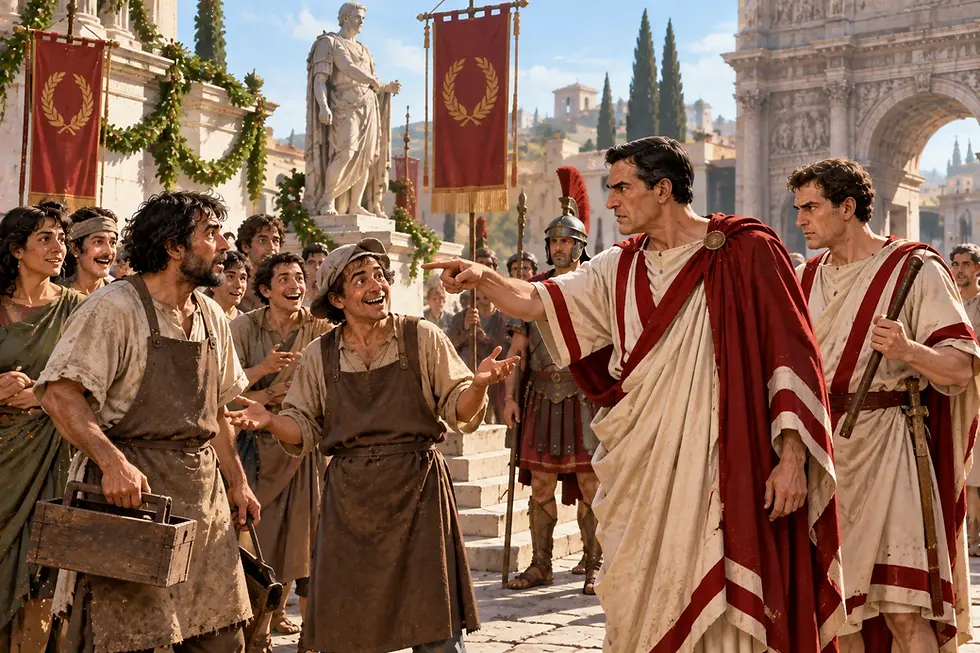
Act I, Scene 1 opens on a bustling public street in Rome where common artisans have assembled in festive attire to celebrate Julius Caesar's triumph over Pompey's sons. Tribunes Flavius and Marullus interrupt the gathering, interrogating a carpenter and a cobbler for abandoning their trade tools on a working day. While the witty cobbler defuses initial hostility with agile puns, Marullus delivers an impassioned reprimand reminding the crowd of their past devotion to Pompey. He reproaches the plebeians as heartless, ungrateful creatures who once thronged walls and battlements to cheer Pompey's chariot, yet now strew flowers along the path of his vanquisher. Moved to shame, the chastised plebeians disperse silently toward the riverbank. Seizing the moment, Flavius directs Marullus to strip ceremonial decorations and laurel crowns from Caesar’s public images to check his rising prestige. Flavius concludes the confrontation with an ominous reflection: plucking these emergent honours from Caesar will keep his ambition within ordinary bounds, preventing him from soaring above his fellow Romans and forcing the populace into subjugated servitude.
SECTION 5 — Character Notes (Act I, Scene 1)
Flavius: A dedicated Roman tribune driven by stern republican vigilance. He perceives the public adoration of Caesar as an impending civic danger rather than harmless merriment. While his haughty dismissal of the working populace reveals class contempt, his calculated resolve to disrobe Caesar's statues demonstrates an active determination to prune autocratic ambition before republican liberties vanish entirely.
Marullus: A fellow tribune distinguished by passionate loyalty to Rome’s past order. Deeply wounded by the citizenry's sudden betrayal of Pompey's memory, his vehement rhetoric denounces public fickleness. Marullus acts as an emotional moral conscience, shaming the commoners into guilt while exposing how volatile popular affection is in
Roman politics.
The Cobbler: A quick-witted artisan whose clever wordplay offers brief comic relief while underscoring ordinary citizens' cheerful indifference to patrician politics.
The common artisans represent the impressionable plebeian collective whose volatile allegiances destabilise Rome's traditional governance.
SECTION 6 — Central Themes
6A. Central Theme
Act I, Scene 1 fundamentally examines the volatility of popular acclaim and the fragile boundary separating celebrated leadership from autocracy. The scene exposes how swiftly mass adulation shifts from one conqueror to another, prompting intense republican dread that unchecked charismatic power will erode ancient civic freedoms.
6B. Key Ideas
The scene highlights the power of political rhetoric to sway public sentiment from jubilation to shame. Additionally, it explores how public symbols, statues, and spectacles are manipulated to construct or dismantle authority.
SECTION 7 — Vocabulary & Key Techniques
7A. Vocabulary in Context
Word/Phrase | Meaning in this Context | Where It Appears |
Mechanical | Belonging to the artisan or manual labouring class; working-class artisans. | Act I, Scene 1 (Flavius) |
Cobbler | Used ambiguously as a shoemaker and an unskilled, bungling workman. | Act I, Scene 1 (Cobbler) |
Awl | A pointed hand tool used to pierce leather; punned playfully with 'all'. | Act I, Scene 1 (Cobbler) |
Tributaries | Captive rulers or provinces compelled to pay tribute and taxes to Rome. | Act I, Scene 1 (Marullus) |
Replication | Resonant echo or acoustic reverberation bouncing off concaved shores. | Act I, Scene 1 (Marullus) |
Intermit | Suspend, postpone, or avert impending divine retributive punishment. | Act I, Scene 1 (Marullus) |
Disrobe | Strip away scarves, garlands, or festive decorations from public monuments. | Act I, Scene 1 (Flavius) |
Pitch | The highest elevation reached by a falcon in flight before it dives. | Act I, Scene 1 (Flavius) |
Servile | Cringing, submissive, and characteristic of enslaved subjects. | Act I, Scene 1 (Flavius) |
7B. Key Techniques
Falconry imagery functions as a dominant metaphor when Flavius compares Caesar’s honors to growing feathers on a raptor's wing, arguing that plucking these accolades forces the potential autocrat to fly at an ordinary pitch rather than dominate the sky. Rhetorical contrast is vividly employed in Marullus's monologue, juxtaposing festive flowers with the blood of defeated Pompey to shame the impressionable plebeians into civic remorse. Furthermore, dramatic irony underpins the entire confrontation, as the commoners' uncritical adulation for their triumphant general directly triggers the patrician panic that will hatch the conspiracy.
SECTION 8 — Extract Practice (Sample Set)
FLAVIUSThese growing feathers plucked from Caesar’s wingWill make him fly an ordinary pitch,Who else would soar above the view of menAnd keep us all in servile fearfulness.
(i) Where does this exchange occur, and what immediate action has Flavius instructed Marullus to carry out? [3]
Flavius speaks these words on a public street in Rome following the dismissal of the holiday crowd. Flavius has directed Marullus to disrobe Caesar's statues and strip away any festive trophies or decorations hung upon them. Additionally, Marullus is instructed to purge the streets of any unlawful assemblies celebrating Caesar's triumph.
(ii) Explain the falconry metaphor embedded in this extract. What do the feathers represent? [3]
The metaphor compares Caesar to a soaring hunting bird whose height depends upon the strength of its wing plumage. Feathers represent the adulation, public decorations, and civil titles heaped upon Caesar by the impressionable populace. Plucking these feathers signifies diminishing his public prestige so that he remains an equal citizen rather than an untouchable monarch.
(iii) What is meant by the phrase "fly an ordinary pitch"? [3]
The word pitch denotes the peak flight altitude achieved by a trained hawk before it dives toward prey. Within this political context, flying an ordinary pitch means keeping Caesar at a standard level of authority shared by other Roman magistrates. The tribunes intend to restrain his political trajectory so that he does not overshadow republican institutions.
(iv) What specific danger does Flavius envision if Caesar's ascent continues unchecked? [3]
Flavius envisions Caesar soaring far beyond the view of mortal men, establishing absolute personal dominion over the state. Such unbridled elevation would reduce Roman patricians and plebeians alike to cringing subjects. The unchecked rise would effectively destroy republican freedom, forcing all citizens into a perpetual state of fearful subservience.
(v) How does this closing speech establish the foundational political tension of the play? Justify with reference to the passage. [4]
Flavius's speech crystallises the central conflict between individual ambition and the survival of republican liberty. Rather than viewing Caesar as an honoured protector, the tribunes interpret his popular triumphs as an existential threat to Roman equality. Flavius's stark phrase "keep us all in servile fearfulness" reveals an aristocratic dread of impending autocracy that prefigures the conspiracy. The passage confirms that the resistance against Caesar begins not on the battlefield, but in the ideological struggle to control civic spaces and public reputation.
SECTION 9 — Short Answer Questions
Q1. Explain the central theme of Act I, Scene 1 in your own words, showing how it shapes the opening conflict.
The central theme centres on the perilous instability of popular sentiment and the looming erosion of constitutional freedom. Rome is depicted as a divided commonwealth where the working masses chase sensory spectacle, while conservative magistrates struggle to preserve republican equilibrium. The clash between the celebrating artisans and the angry tribunes demonstrates that tyranny often arises through the voluntary surrender of civic vigilance by an easily manipulated populace. Consequently, the opening scene establishes that autocratic rule takes root when charismatic triumph eclipses civic duty.
Q2. Do you think Flavius and Marullus are justified in rebuking the commoners and stripping the statues? Give reasons for your view.
Flavius and Marullus are politically justified from a republican perspective, even if their arrogant demeanour towards the artisans is unnecessarily abrasive. Their alarm over the crowd’s shallow devotion is valid, as the citizens readily abandon their long-standing admiration for Pompey to applaud the very general who shed Pompey’s blood. Stripping the decorated statues serves as a necessary symbolic restraint against a burgeoning personality cult that threatens the Senate's authority. Although their contemptuous words show little empathy for the working classes, their defensive actions stem from a genuine desire to preserve Rome from monocracy and servitude.
CLOSING — Premium Resource Pointer
For comprehensive chapter mastery, our complete PDF Study Package offers full-act scene maps, extensive comparative tables, dedicated objective question practice, and multiple specimen-aligned 16-mark extract sets with examiner marking schemes.


