

Act 1, Scene 2 - William Shakespeare- ICSE - IX
SECTION 1 — Act & Scene Information
Play: Julius Caesar
Playwright: William Shakespeare
Portion Covered: Act I, Scene 2
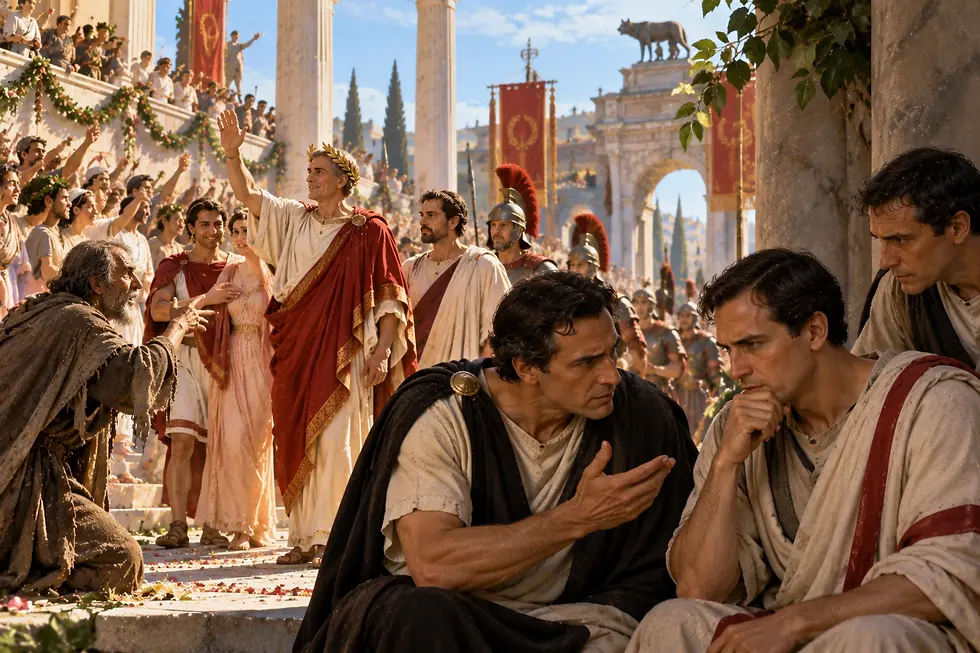
Setting: A public place in Rome during the Feast of Lupercal
Course: ICSE Class 9 English Literature (CISCE)
Exam Component: Modelled on the official Class IX specimen Drama section (16 marks) — a school-level Class IX assessment standard, not a centrally administered ICSE board paper.
SECTION 2 — About the Play & Playwright
William Shakespeare (1564–1616) was an English playwright and poet widely regarded as the foremost dramatist of the Elizabethan and Jacobean eras. Writing primarily for the Globe Theatre in London, Shakespeare drew upon historical chronicles and classical accounts to examine the moral dilemmas, vulnerabilities, and shifting political fortunes of human rulers across varied historical settings.
Julius Caesar is a political tragedy about ambition, authority, and republican liberty. The drama dramatises the internal tensions of ancient Rome, highlighting the profound conflict between personal affection and civic duty as influential senators confront a victorious leader whose supreme authority threatens republican governance.
SECTION 3 — Scene Map
Scene | What Happens |
Act I, Scene 2 | Caesar ignores the Soothsayer's warning at Lupercal, while Cassius exploits Brutus's troubled conscience and plans forged citizen letters to instigate conspiracy. |
SECTION 4 — Summary
Act I, Scene 2 transitions from civic unrest to political spectacle as Julius Caesar leads a ceremonial procession during the Feast of Lupercal. Caesar instructs Mark Antony to touch Calpurnia during the ritual footrace to dispel her barrenness, illustrating his autocratic sway and superstitious mindset. A Soothsayer pierces the fanfare with the cryptic prophecy to beware the Ides of March, but Caesar brushes him off as an idle dreamer and departs. Left behind, Cassius detects an introspective heaviness in Marcus Brutus and initiates a subtle psychological campaign. Rather than attacking Caesar directly, Cassius praises Brutus's nobility and contrasts Caesar’s godlike stature with mortifying episodes of physical frailty, recalling his near-drowning in the turbulent Tiber and a delirious fever in Spain. He insists that Roman subjugation is a choice of timid men rather than a mandate of destiny. Although Brutus confesses his dread of Caesar being crowned king, he remains divided between private affection and patriotic duty. After Brutus withdraws to ponder the crisis, Cassius resolves to complete his seduction by hurling pseudonymous petitions through Brutus's windows to deceive him into believing Rome clamours for his intervention.
SECTION 5 — Character Notes (Act I, Scene 2)
Cassius: A shrewd, fiercely observant patrician whose hatred of Caesar blends authentic republican ideology with venomous personal resentment. He perceives that Brutus's impeccable reputation is indispensable for validating an insurrection. Adapting his rhetoric to Brutus's aristocratic vanity, Cassius weaponises Caesar’s physical frailties, philosophical fatalism, and ancestral obligations. His soliloquy reveals an unscrupulous willingness to forge public letters, exposing his cunning opportunism.
Marcus Brutus: A principled Roman senator plagued by severe internal turmoil. While deeply affectionate toward Caesar personally, Brutus prizes the preservation of republican liberty above private ties. His contemplative, solemn temperament renders him susceptible to high-minded appeals regarding honour and civic duty, establishing the tragic vulnerability that Cassius systematically exploits throughout their dialogue.
Julius Caesar: A commanding yet paradoxically vulnerable statesman. In public, Caesar projects imperious, supreme authority, issuing decrees in the third person and dismissing prophetic warnings with aristocratic disdain. Yet his reliance on fertility superstitions, physical infirmities, and suspicion of Cassius's lean countenance expose a mortal man masked by political posturing.
Mark Antony serves as Caesar’s devoted sycophant, while Calpurnia and the Soothsayer represent early omens of domestic anxiety and supernatural foresight that Caesar imperiously discounts.
SECTION 6 — Central Themes
6A. Central Theme
Act I, Scene 2 explores how charismatic autocracy is forged through public mythmaking and citizen complicity, counterbalanced by the subversive power of calculated rhetoric. The scene demonstrates that tyrannical dominance does not spring from supernatural fate, but rather from the psychological surrender of a cowed society alongside the manipulative cunning of rival politicians.
6B. Key Ideas
Cassius's philosophical distinction between celestial destiny and human agency emphasizes personal responsibility over passive fatalism. Concurrently, the sharp contrast between Caesar's godlike aura and his frail physical constitution highlights the recurring conflict between public spectacle and mortal reality.
SECTION 7 — Vocabulary & Key Techniques
7A. Vocabulary in Context
Word/Phrase | Meaning in this Context | Where It Appears |
Lupercal | An ancient Roman fertility festival celebrated annually on 15 February. | Act I, Scene 2 (Caesar) |
Soothsayer | A prophetic seer or diviner claiming foreknowledge of future events. | Act I, Scene 2 (Stage Direction) |
Ides | The central division of the Roman month, falling on the 15th of March. | Act I, Scene 2 (Soothsayer) |
Gamesome | Inclined toward sports, merriment, or athletic diversions; lively. | Act I, Scene 2 (Brutus) |
Colossus | A gigantic bronze statue; specifically evoking the ancient Colossus of Rhodes. | Act I, Scene 2 (Cassius) |
Underlings | Subservient, powerless subordinates possessing inferior status or agency. | Act I, Scene 2 (Cassius) |
Bestride | To stand straddling over something with legs extended on either side. | Act I, Scene 2 (Cassius) |
Feeble | Lacking physical stamina, vigor, or bodily strength; debilitated. | Act I, Scene 2 (Cassius) |
Aim | An intuitive guess, inkling, or partial comprehension of intent. | Act I, Scene 2 (Brutus) |
7B. Key Techniques
Shakespeare employs dramatic irony when Caesar derides the Soothsayer as a mere dreamer, as the audience recognizes that the ignored prophecy foretells the exact date of his brutal murder. Cassius’s Colossus metaphor provides striking visual rhetoric, depicting Caesar as a gargantuan bronze figure striding across the empire while free Romans scurry beneath his legs like petty vermin. Furthermore, Cassius’s soliloquy at the scene's conclusion operates as structural dramatic irony, granting the audience privileged insight into his plan to deceive Brutus through manufactured public petitions.
SECTION 8 — Extract Practice (Sample Set)
CASSIUSWhy, man, he doth bestride the narrow worldLike a Colossus, and we petty menWalk under his huge legs and peep aboutTo find ourselves dishonourable graves.Men at some time are masters of their fates:The fault, dear Brutus, is not in our stars,But in ourselves, that we are underlings.
(i) Where does this exchange take place, and what public occasion surrounds the speakers? [3]
Cassius utters these words in a public thoroughfare in Rome during the celebratory Feast of Lupercal. Julius Caesar and his grand procession have briefly departed to attend the festival races. Cassius has deliberately detained Marcus Brutus to gauge his inward melancholy and probe his political loyalties regarding Caesar’s ascent.
(ii) Explain the mythological allusion to the Colossus. What political point does Cassius emphasize through this comparison? [3]
Cassius alludes to the famed Colossus of Rhodes, a colossal bronze effigy of the sun god Helios that stood astride an ancient harbour. Through this visual hyperbole, Cassius illustrates Caesar’s disproportionate political dominance over the Mediterranean world. The comparison emphasizes that Caesar has unnaturally elevated himself above his peers, reducing fellow patricians to puny subordinates scurrying beneath his shadow.
(iii) What is meant by the phrase "The fault... is not in our stars"? [3]
Cassius’s phrase rejects the prevailing belief that astrological alignments or cosmic fate dictate human servitude. Within this context, the assertion claims that passive submission to an autocrat is a moral failing of human will rather than a divine destiny. Cassius insists that free Roman citizens possess the agency to dismantle oppression if they dare to act.
(iv) Identify two narrative anecdotes Cassius presents in this scene to challenge Caesar's heroic reputation. [3]
Cassius recounts challenging Caesar to swim across the stormy, raging waters of the Tiber River, wherein Caesar faltered and pleaded for rescue like an exhausted swimmer. Furthermore, Cassius recalls Caesar collapsing from a feverish seizure during a military campaign in Spain. During that affliction, Caesar groaned, trembled, and whimpered for water like a feeble, sickly child.
(v) How does this passage reveal Cassius’s rhetorical method and strategic objective with Brutus? Justify with reference to the lines. [4]
Cassius crafts his rhetoric to provoke Brutus's patrician pride by framing Caesar's elevation as an intolerable civic degradation. By contrasting the towering Colossus with petty men seeking dishonourable graves, Cassius forces Brutus to confront the shame of passive subservience. The appeal to free will directly prods Brutus’s celebrated lineage, challenging him to demonstrate republican courage rather than tolerate tyranny. Ultimately, Cassius does not rely on objective civic logic alone; he deliberately shames Brutus's honour to make rebellion appear as a moral imperative.
SECTION 9 — Short Answer Questions
Q1. Explain the central theme of Act I, Scene 2 in your own words, showing how persuasion operates as an engine of political action.
Act I, Scene 2 reveals that authoritarian dominance depends upon popular passivity, whereas revolutionary conspiracies are forged through tailored psychological manipulation. Shakespeare demonstrates that political allegiances are seldom spontaneous; rather, they are calculated through rhetorical artistry. Cassius diagnoses Brutus’s specific vulnerabilities—his solemn sense of honour and ancestral prestige—and sculpts arguments designed to make treason resemble a sacred republican restoration. Thus, the scene demonstrates that rhetoric serves as the primary catalyst transforming private resentment into public catastrophe.
Q2. Do you think Cassius's arguments against Caesar in this scene reflect authentic patriotism or personal jealousy? Give reasons for your view.
Cassius acts from an inseparable combination of philosophical republicanism and bitter personal resentment. His philosophical defense of Roman parity and condemnation of tyranny align legitimately with republican traditions that resist singular monarchy. Nevertheless, his obsessive dwell on Caesar's physical infirmities—such as his near-drowning and Spanish fever—exposes deep narcissistic envy toward an equal who has outstripped him in prestige. His closing soliloquy, which outlines the covert fabrication of forged letters, ultimately confirms that personal malice and manipulative cunning taint his high-minded civic grievances.
CLOSING — Premium Resource Pointer
For comprehensive chapter mastery, our complete PDF Study Package offers full-act scene maps, extensive comparative tables, dedicated objective question practice, and multiple specimen-aligned 16-mark extract sets with examiner marking schemes.


