

Act 3, Scene 4 - William Shakespeare - ISC - Std XII
- Aug 27
- 8 min read
Updated: 4 days ago
Section 1 — Act Information
Play: Macbeth
Playwright: William Shakespeare
Act Covered: Act III, Scene 4
Scenes in this Act: Act III, Scene 4 (The Banquet Hall in the Palace at Forres)
Course: ISC Class 12 Literature in English (CISCE)
Exam Component: Theory Paper, Section B, Drama (20 marks)
Section 2 — About the Play & Playwright
William Shakespeare (1564–1616) was an English dramatist, poet, and actor whose work defined the Elizabethan and Jacobean stages. Composed around 1606 during the reign of King James I, his plays engaged deeply with contemporary concerns regarding monarchical legitimacy, divine order, the sanctity of sovereign rule, and the spiritual disorder generated by regicide.
Macbeth is a compact tragedy investigating the moral decay of an ambitious warrior who seizes the Scottish throne. The drama explores the torment of guilt, the futility of escaping fate, the psychological consequences of bloodlust, and the inevitable collapse of usurped authority into unhinged tyranny.
Section 3 — Scene Map
Scene | What Happens |
Act III, Scene 4 | Macbeth hosts a state banquet; the First Murderer reports Banquo's death and Fleance's escape, whereupon Banquo's ghost appears in the royal seat, precipitating Macbeth's public collapse and the abrupt dismissal of the court. |
Section 4 — Summary
Act III, Scene 4 opens in the palace banquet hall as Macbeth and Lady Macbeth welcome the Scottish nobility to a formal feast. At the threshold, the First Murderer secretly delivers his report: Banquo has been slain, but Fleance has escaped. While relieved by Banquo's end, Macbeth is instantly plunged back into paranoid confinement by Fleance's survival, describing the youth as a fleeing worm that will eventually breed venom.
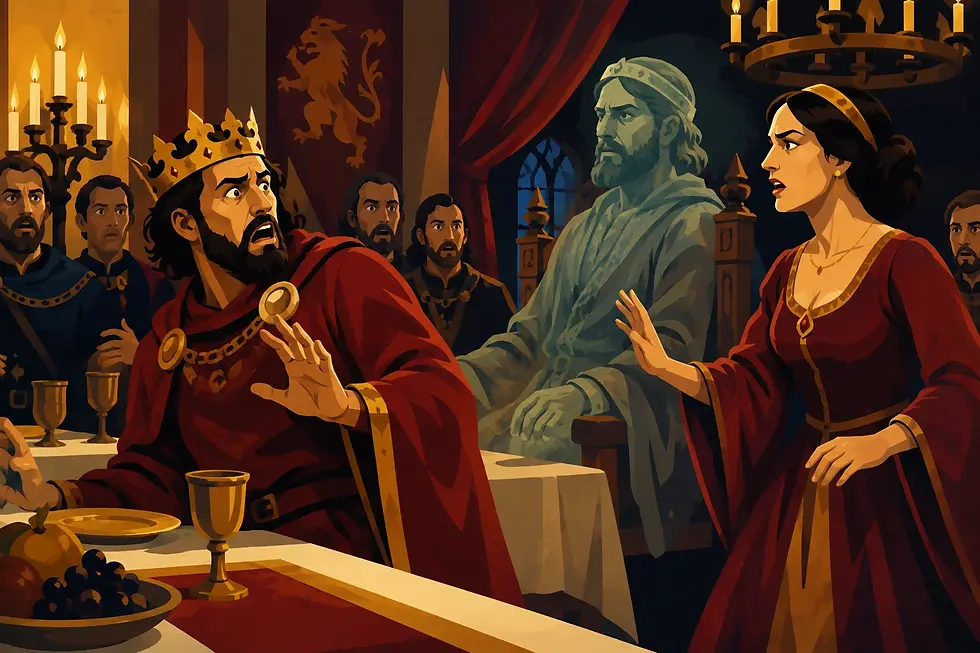
Returning to the table, Macbeth finds his royal chair occupied by the bloodied ghost of Banquo, visible only to him. Overcome with terror, Macbeth utters frantic denials that expose his guilt. Lady Macbeth intervenes, assuring the alarmed lords that the king suffers from a passing childhood affliction while privately rebuking his masculinity. When the ghost vanishes, Macbeth attempts recovery and hypocritically toasts Banquo's memory, only for the apparition to reappear. As Macbeth's hysteria intensifies, Lady Macbeth abruptly dismisses the assembly without regard to aristocratic rank. Left alone, Macbeth reflects that blood will have blood, notes Macduff's defiance, reveals his paid network of household spies, and resolves to revisit the weird sisters, declaring himself so steeped in a river of blood that returning is as difficult as advancing.
Section 5 — Character Notes (This Act)
Macbeth
Macbeth exhibits profound psychological disintegration, unmanageable guilt, and despotic hardening. Although he possesses the physical courage to face wild beasts, he collapses before the moral accusation embodied by Banquo's ghost. Reaching a fatal turning point, he abandons deliberation, relying on domestic espionage and resolving that immediate violent impulses must become instant actions.
Lady Macbeth
Lady Macbeth displays desperate tactical crisis management alongside collapsing influence. She fiercely tries to preserve their royal façade by inventing medical excuses for the court and scorning her husband's visionary terror. However, her inability to calm his frenzy forces her to break court etiquette, ending the feast in chaos and revealing the limits of her psychological dominance.
Banquo's Ghost
Banquo's silent, bloodied phantom serves as a dramatic embodiment of supernatural retribution and Macbeth's suppressed conscience. By usurping Macbeth's throne, the ghost physically manifests the unlineal fate Macbeth dreads, demonstrating that the dead continue to challenge and unseat his stolen majesty.
Minor Characters
The First Murderer exemplifies Macbeth's moral degradation as a king who lauds cutthroats, while Ross, Lennox, and the Scottish lords bear silent witness to the regime's unravelling stability and emerging despotism.
Section 6 — Central Themes
6A. Theme
Act III, Scene 4 centers on the inescapable retribution of crime and the utter collapse of sovereign legitimacy under the weight of guilt. Shakespeare dramatizes that worldly power gained through murder cannot suppress conscience, as suppressed atrocities inevitably resurface to shatter the ruler's sanity and authority.
6B. Ideas / Concerns / Emotional Movement
Appearance versus reality is exposed as formal royal hospitality dissolves into chaotic hysteria, while the inevitability of moral consequence is captured in the principle that "blood will have blood." Dramatically, the scene moves from aristocratic ceremony to claustrophobic horror, public humiliation, and finally a cold, grim commitment to unbridled tyranny.
Section 7 — Vocabulary & Key Techniques
7A. Vocabulary in Context
Word/Phrase | Meaning IN THIS CONTEXT | Where It Appears |
Degrees | Social ranks, orders of nobility, and corresponding seating precedence. | Act III, Scene 4 |
Cabined, cribbed, confined | Trapped, shut in, restricted, and psychologically imprisoned by fear. | Act III, Scene 4 |
Gory locks | Blood-matted hair on the slaughtered victim's head. | Act III, Scene 4 |
Maws of kites | The bellies or stomachs of birds of prey and scavenging raptors. | Act III, Scene 4 |
Admired disorder | Disorder that causes great astonishment, wonder, or bewildered amazement. | Act III, Scene 4 |
Speculation | Power of sight, intelligent vision, or conscious perception in the eyes. | Act III, Scene 4 |
Fee'd | Bribed, kept on a secret payroll, or paid to act as an informant. | Act III, Scene 4 |
Betimes | Early in the morning, speedily, or with all deliberate haste. | Act III, Scene 4 |
Scanned | Examined closely, carefully considered, or deliberated upon. | Act III, Scene 4 |
Season of all natures | The natural preservative and necessary restorative of all living beings (sleep). | Act III, Scene 4 |
7B. Key Techniques
Shakespeare employs powerful dramatic irony during the banquet, as Macbeth's hypocritical toast to his "dear friend Banquo" immediately summons the slaughtered nobleman's ghost to confront him. The supernatural serves as an externalized manifestation of internal guilt, where the phantom's silent occupation of the royal seat visually symbolizes disputed kingship and dynastic retribution. Furthermore, the extensive river-of-blood metaphor conveys Macbeth's moral fatalism, portraying evil as an inescapable current where retreat is as arduous as further slaughter.
Section 8 — Structured Long-Answer Practice (One Sample Set)
(i) Examine the encounter between Macbeth and the First Murderer at the banquet door in Act III, Scene 4. How does Macbeth react to the news of Banquo's death and Fleance's escape? [5]
"Then comes my fit again: I had else been perfect, / Whole as the marble, founded as the rock..."
Macbeth greets the First Murderer with praise, lauding him as the best of cutthroats upon hearing that Banquo's throat has been slashed and his corpse abandoned in a ditch. This gory confirmation brings him momentary relief, as his most immediate noble rival has been removed. However, the news of Fleance's escape instantly shatters his composure, plunging him back into intense psychological confinement. Macbeth laments that he has been rendered "cabined, cribbed, confined," bound once again to saucy doubts and fears instead of achieving rock-like security. Employing serpent and worm imagery, Macbeth rationalizes that while the mature serpent Banquo is dead, the fled worm Fleance will eventually breed venom, recognizing that the threat to his dynastic security remains actively alive.
(ii) Analyze Lady Macbeth's attempts to manage the crisis during the banquet in Act III, Scene 4. How does she address the noble guests and reprimand her husband? [5]
"O proper stuff! / This is the very painting of your fear..."
Lady Macbeth engages in desperate damage control to preserve the royal couple's authority and prevent incriminating confessions. Addressing the startled Scottish nobles, she smoothly invents an explanation, claiming that Macbeth has suffered from momentary visionary fits since his youth and urging the guests to ignore the outburst so as not to inflame his condition. In sharp contrast, she turns on Macbeth in private with biting scorn, asking "Are you a man?" and mocking his trembling terror. She dismisses Banquo's ghost as a mere "painting" of his fear, comparing the hallucination to the visionary dagger that led him to Duncan. When Macbeth's hysteria erupts a second time, she abandons ceremonial protocol entirely, commanding the thStatus nobility to depart immediately without standing upon the order of their going.
(iii) Answer (a) or (b) [10]
(a) Discuss how the banquet scene (Act III, Scene 4) marks the public collapse of Macbeth's royal legitimacy and reveals his complete descent into tyranny. Support your answer with close textual evidence. [10]
Act III, Scene 4 represents the decisive public ruin of Macbeth's monarchical facade, exposing the fatal instability at the heart of his usurped regime. In Renaissance drama, a royal banquet was the supreme ceremonial manifestation of state harmony, social degree, and legitimate authority. Macbeth opens the feast with an attempt to appear as an accessible, benevolent monarch who will mingle with his subjects. However, this illusion of legitimate kingship disintegrates the moment Banquo's bloodied ghost occupies his vacant throne, visually dramatizing that Macbeth's title is illegitimate and contested by the victims of his ambition.
Macbeth's hysterical outbursts before his court permanently destroy his regal credibility. By frantically declaring, "Thou canst not say I did it," he inadvertently signals his complicity in covert violence to the assembled lords. His loss of rational control reduces the royal feast to "admired disorder," compelling Lady Macbeth to dismiss the nobility without regard to rank. This chaotic conclusion visually and politically shatters the social order that a legitimate sovereign is sworn to uphold, leaving the Scottish aristocracy alienated and deeply suspicious.
In the aftermath of the court's departure, Macbeth fully embraces despotic governance. Recognizing that "blood will have blood," he chooses escalation over repentance. He reveals that he maintains paid spies in every nobleman's household, turning Scotland into a surveillance state founded on mutual dread. Noting Macduff's deliberate absence, he resolves to visit the weird sisters for supernatural reassurance and pledges to act on violent impulses without moral reflection. Thus, the scene decisively marks Macbeth's transition from an anxious usurper into an isolated, bloodthirsty tyrant.
OR
(b) "I am in blood / Stepped in so far that, should I wade no more, / Returning were as tedious as go o'er." Analyze how Act III, Scene 4 illustrates Macbeth's psychological crisis and his moral fatalism. [10]
Macbeth's famous metaphor of wading across a river of blood encapsulates the acute psychological crisis and moral despair governing his psyche in Act III, Scene 4. Having pursued ambition through regicide and assassination, Macbeth finds that sovereign power brings no mental sanctuary. Instead, his guilty conscience manifests as intense paranoia and terrifying supernatural hallucinations. Although he boasts the physical valor to confront a Russian bear, an armed rhinoceros, or a Hyrcanian tiger, he is paralyzed by the silent, accusing glare of Banquo's ghost, proving that his inner torment transcends physical courage.
This psychological agony leads directly to moral fatalism. Rather than seeking spiritual redemption or acknowledging the horrific cost of his crimes, Macbeth adopts a hardened, nihilistic resolve. By visualizing his murders as an expansive river of blood, he rationalizes that retreating toward moral righteousness would be just as exhausting and hazardous as advancing into further atrocities. He consciously abandons the hope of salvation, concluding that because his soul is already damned, self-preservation through continuous violence is his only remaining path.
Furthermore, Macbeth decides to extinguish his conscience entirely to survive. Acknowledging that he lacks "the season of all natures, sleep," he attributes his panic to the unhardened squeamishness of a novice killer, declaring that they are "yet but young in deed." To suppress future remorse, he resolves that strange thoughts in his head must become instant actions before intellect can evaluate them. Through this surrender to fatalism, Shakespeare illustrates how unresolved guilt corrodes the moral imagination, driving the tragic protagonist into a reckless, self-perpetuating cycle of slaughter.
Section 9 — Personal Response Question
Q. What thoughts and feelings does Macbeth's terror before the silent ghost of Banquo in Act III, Scene 4 evoke in you regarding the power of conscience? Explain your response with reference to the text.
Answer: Macbeth's confrontation with Banquo's silent ghost evokes a profound sense of psychological dread and moral justice, demonstrating that an individual cannot silence the accusations of conscience through political power. While Macbeth successfully orchestrates Banquo's physical death, he cannot banish Banquo from his mind. The ghost's absolute silence is far more terrifying than spoken condemnation because Macbeth's own guilt projects the horror onto the empty seat. This dramatic moment illustrates that external triumph is meaningless when one is internally tormented. Shakespeare invites the audience to recognize that no degree of royal authority or despotic violence can shield a perpetrator from the devastating internal retribution exacted by their own corrupted moral nature.
Closing — Premium Resource Pointer
These study notes provide an essential foundation for the dramatic conflict, psychological unravelling, and themes within Act III, Scene 4. For comprehensive examination preparation, our premium PDF notes provide a second full ISC-style long-answer practice set, Section A objective practice, cross-Act synthesis, and targeted exam-error guidance.


