

Death of a Naturalist - Seamus Heaney - ISC - Std XI
SECTION 1 — Poem Information
Poem Title: Death of a Naturalist
Poet: Seamus Heaney
Course: ISC Class 11 Literature in English (CISCE)
Anthology: Rhapsody: A Collection of ISC Poems
Exam Component: Theory Paper, Section B, Poetry (20 marks)
SECTION 2 — About the Poet
Seamus Heaney (1939-2013) was a Northern Irish poet, playwright, and translator who received the Nobel Prize in Literature in 1995. Renowned for his tactile descriptions of the rural Ulster landscape, his verse often uncovers the psychological, cultural, and moral complexities underlying pastoral existence. Serving as the title poem of his landmark 1966 debut collection, "Death of a Naturalist" draws directly on rural childhood memories to dramatize the transition from juvenile wonder to adolescent alienation. Heaney uses physical imagery of biological decay and amphibian life to transform an ordinary country memory into an allegory of maturing consciousness.
SECTION 3 — Stanza Map
Structural Unit | What It's About (1 line) |
Movement 1 — The Flax-Dam (Stanza 1 opening) | The child observes the decaying, sweltering flax-dam with curiosity rather than disgust. |
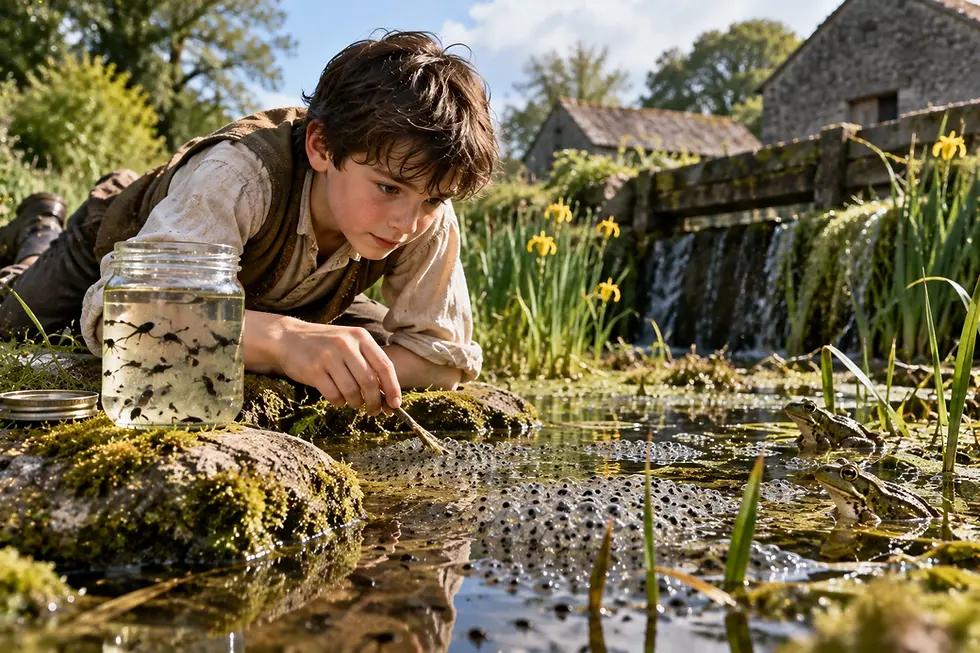
Movement 2 — Collecting Frogspawn (Stanza 1 middle) | The young naturalist gathers frog eggs annually in glass jars to watch them hatch. |
Movement 3 — Classroom Lessons (Stanza 1 close) | Miss Walls teaches an innocent, sanitized life cycle of the "mammy" and "daddy" frogs. |
Movement 4 — The Sudden Invasion (Stanza 2 opening) | A suffocatingly hot day brings a swarm of aggressive adult frogs to the flax-dam. |
Movement 5 — Military Frogs (Stanza 2 middle) | The creatures appear menacing and weapon-like, croaking in an oppressive bass chorus. |
Movement 6 — The Symbolic Death (Stanza 2 close) | Sickened by fear of vengeance from the "slime kings," the boy flees, abandoning nature. |
SECTION 4 — Stanza-wise Meaning
Stanza 1: Childhood Fascination and Orderly Knowledge
Text Reference: Opening with the festering flax-dam in the townland and the boy's annual collection of frogspawn.
Meaning: The young speaker recalls spending summers beside a stagnant pool filled with rotting vegetation, swarming bluebottles, and bubbling slime. Instead of being repulsed by this organic decay, the child approaches it with scientific absorption, filling glass jam jars with jellied frogspawn to observe tadpoles emerge on his windowsill. His teacher, Miss Walls, supplies an orderly domestic narrative of "daddy" and "mammy" frogs that keeps reproduction familiar and safe. At this stage, nature is an educational playground where the boy feels complete mastery over living things.
Stanza 2: The Confrontation and Loss of Innocence
Text Reference: The turning point beginning with "Then one hot day" when the field smells of cow dung and the dam is overrun.
Meaning: A sudden oppressive heatwave brings a dense infestation of mature frogs whose croaks resemble a threatening military chorus. Their swollen bellies, aggressive postures, and coarse movements transform the previously benign flax-dam into a hostile landscape. The boy interprets their presence as an organized army of "slime kings" gathered to take vengeance for his theft of their spawn. Overcome by panic and physical revulsion, he runs away, marking the death of his boyhood identity as an inquisitive naturalist.
SECTION 5 — Central Theme and Mood
5A. Theme The poem centers on the loss of childhood innocence and the transition into adolescent consciousness. Heaney demonstrates that maturing involves recognizing the raw, uncontrollable power of biological reproduction and bodily decay, which disrupts childhood fantasies of safe, orderly nature. The death described is psychological: it marks the collapse of naive wonder when confronted with the reality of nature's power.
5B. Tone / Emotional Movement The tone begins in a rich, sensory register of childhood curiosity, delighting in mud, insects, and gelatinous eggs. With the dramatic shift in the second stanza, this playful engagement turns into visceral disgust, dread, and claustrophobic unease. By the end, the emotional atmosphere shifts to genuine panic, leaving the speaker alienated from the natural world he once loved.
5C. Key Ideas The text distinguishes between sanitized textbook knowledge and the disturbing reality of firsthand physical experience. It also highlights how external nature remains unchanged in its processes, while shifting human perception determines whether those processes appear wonderful or horrifying.
SECTION 6 — Vocabulary in Context
Word / Phrase | Meaning IN THIS CONTEXT | Line / Stanza Reference |
Flax-dam | A rural pool where harvested flax was submerged to rot and soften | Stanza 1, Line 1 |
Festered | Decayed, rotted, and fermented under the heavy heat | Stanza 1, Line 2 |
Townland | A traditional rural territorial division in Ireland | Stanza 1, Line 3 |
Bluebottles | Large flies with iridescent blue bodies attracted to rotting matter | Stanza 1, Line 5 |
Slobber | Thick, wet, gelatinous mass of frogspawn | Stanza 1, Line 8 |
Gross-bellied | Having swollen, bloated abdomens filled with air or food | Stanza 2, Line 27 |
Poised | Stationed steadily in an aggressive, ready-to-strike stance | Stanza 2, Line 28 |
Slime kings | Mythologized adult frogs perceived by the child as grotesque rulers | Stanza 2, Line 31 |
Vengeance | Retaliation imagined by the boy for stealing their unhatched eggs | Stanza 2, Line 32 |
SECTION 7 — Poetic Devices
Device | Exact Quoted Phrase or Line | Effect | Stanza # |
Sensory Imagery | "bubbles gargled delicately" / "smell of cowdung" | Evokes rich auditory and olfactory textures of rural decay, placing the reader in the marsh. | Stanzas 1 & 2 |
Military Metaphor | "loose necks pulsed like snails" / frogs poised like grenades | Re-imagines harmless amphibians as an invading, weaponized infantry ready for combat. | Stanza 2 |
Personification | Frogs gathered for "vengeance" | Projects the boy's internal guilt and panic onto the natural actions of the animals. | Stanza 2 |
Onomatopoeia | "croaking" / "gargled" / "slap and plop" | Re-creates the damp, rhythmic sounds of the wetland to make the scene immediate. | Stanzas 1 & 2 |
Form and Verse: The poem is composed in blank verse (unrhymed iambic pentameter) divided into two unequal stanzas. Heaney introduces heavy enjambments, dense consonant clusters, and conversational cadences that mirror the speaker's emotional shift from comfortable curiosity to hurried retreat.
SECTION 8 — Structured Long-Answer Practice (One Sample Set)
(i) How does Heaney present the flax-dam in the first stanza to illustrate the child's fascination with nature? [5] Incorporate: (a) The sensory details of decay and organic life (b) The child's lack of revulsion
Model Answer: Heaney renders the flax-dam through intense sensory descriptions of fermentation, bubbling water, and swarming bluebottles. The stagnant pool festered under the hot sun, emitting strong smells of rotting vegetation. However, this organic decomposition does not disgust the young boy. Instead, the child views the pool as a living laboratory, admiring how bubbles gargled delicately and taking interest in dragonfly spots and buzzing insects. His eagerness to gather frogspawn demonstrates that youthful innocence can discover wonder and scientific curiosity in an environment that adult observers might find filthy and repulsive.
(ii) Explain the significance of the turning point marked by "Then one hot day" in the second stanza. [5] Incorporate: (a) The transformation in atmospheric and physical imagery (b) The sudden psychological shift from confidence to fear
Model Answer: The transitional phrase "Then one hot day" marks a dramatic shift in both atmosphere and the speaker's psychological state. The sensory environment turns oppressive, filled with the rank smell of cow dung and the harsh noise of an amphibian invasion. Frogs that were once viewed as harmless creatures now appear grotesque, with swollen bellies and aggressive postures. This sudden change destroys the boy's sense of control. The physical transformation of the dam reflects his shift from innocent childhood curiosity to adolescent anxiety, where nature suddenly appears menacing and impossible to dominate.
(iii) [WHOLE-POEM QUESTION — INTERNAL CHOICE]
(a) "The title Death of a Naturalist refers to a psychological death rather than a physical one." Discuss this statement with reference to the poem. [10]
Model Answer: The title Death of a Naturalist functions as a metaphor for the collapse of childhood innocence and scientific wonder. In the opening stanza, the young speaker behaves like an apprentice naturalist, exploring the wetland, gathering frogspawn in glass jars, and observing tadpoles hatch on window sills. His relationship with nature is guided by Miss Walls's gentle, domestic lessons about "mammy" and "daddy" frogs, allowing him to observe reproduction without fear.
This innocent perspective dies when the boy encounters mature adult frogs during a stifling summer day. The creatures no longer resemble harmless specimens; instead, their guttural croaking and bloated forms terrify the young observer. Projecting his own guilt and fear onto the animals, he views them as "slime kings" poised to exact revenge for his stolen spawn.
When the boy turns and flees in disgust, he loses his former curiosity. The confident child who freely scooped up biological specimens now fears being entrapped by the slime. The death is entirely psychological: it signals the demise of the boy's naive assumption that nature can be safely observed and managed without encountering its raw, disturbing realities.
OR
(b) Examine how Heaney contrasts the two stanzas to explore the division between innocence and experience. [10]
Model Answer: Heaney uses the two-stanza structure of Death of a Naturalist to dramatize the psychological crossing from childhood innocence to experienced awareness. The first stanza, which is longer and observational, embodies the stage of innocence. Here, the boy approaches the decomposing wetland with affection, collecting amphibian eggs and watching tadpoles grow into nimble swimmers. The language emphasizes curiosity, and reproduction is explained through comforting nursery terms.
The second stanza disrupts this safe world through an encounter with adult experience. Oppressive heat, rank farmyard odors, and an aggressive chorus of croaks replace the pleasant observations of the classroom. Heaney shifts from domestic imagery to military similes: the mature frogs are compared to poised grenades and charging infantry. Nature is no longer an innocent hobby; it becomes an overwhelming, sexually mature force.
Crucially, the physical flax-dam has not altered its natural processes; only the speaker's maturing consciousness has transformed his perspective. By placing gentle wonder beside visceral disgust, Heaney shows that growing up shatters sanitized childhood illusions, forcing an individual to confront the unruly and threatening realities of biological life.
SECTION 9 — Personal Response Question
Q. What does this poem invite you to think or question about the way growing up alters our relationship with the physical world? Explain your response with reference to the poem.
Answer: Heaney's poem illustrates that growing up alters our perception of the physical world by stripping away comfortable illusions. As a child, the speaker plays with decaying matter and collects frogspawn without anxiety because he sees nature through an innocent lens. When he confronts the adult frogs, however, his newly emerging awareness reads threat, sexuality, and malice into their natural behavior. This shows that fear often stems from our own maturing imaginations rather than changes in the environment itself. The text makes me realize that adulthood brings an awareness of mortality and bodily vulnerability that makes it difficult to regain naive childhood wonder.
CLOSING
These study notes outline the sensory progression, psychological turning points, and CISCE examination formats for "Death of a Naturalist". For comprehensive exam preparation, our full PDF Notes provide an additional 20-mark practice set, detailed Section A objective banks, complete critical appreciation frameworks, and CISCE marking scheme guidance.


