

There Will Come Soft Rains - Ray Bradbury- ISC - XII
- 2 hours ago
- 11 min read
SECTION 1 — Story Information
Story Title: There Will Come Soft Rains
Author: Ray Bradbury
Course: ISC Class 12 Literature in English (CISCE)
Anthology: PRISM: A Collection of ISC Short Stories (Evergreen Publications)
Exam Component: Theory Paper, Section B, Prose (20 marks)
SECTION 2 — About the Author
Ray Douglas Bradbury (1920–2012) was a celebrated American author of speculative fiction, fantasy, and science fiction, renowned for seminal works such as Fahrenheit 451 and The Martian Chronicles. Bradbury's lyrical prose frequently explored the ethical hazards of technological dependence, nuclear destruction, and human alienation. In "There Will Come Soft Rains," he presents an entirely automated house carrying out its scheduled rituals in a post-nuclear landscape. By dramatising absence, mechanical habit, and ecological indifference, Bradbury delivers a cautionary critique of technological hubris and humanity's capacity for self-annihilation.
SECTION 3 — Narrative Progression Map
Narrative Beat | What Happens |
The Automated Dawn | The voice-clock sounds the morning alarm and commands an absent household to begin the day. |
The Untouched Breakfast | The robotic kitchen prepares a full breakfast that goes unconsumed and is scraped away. |
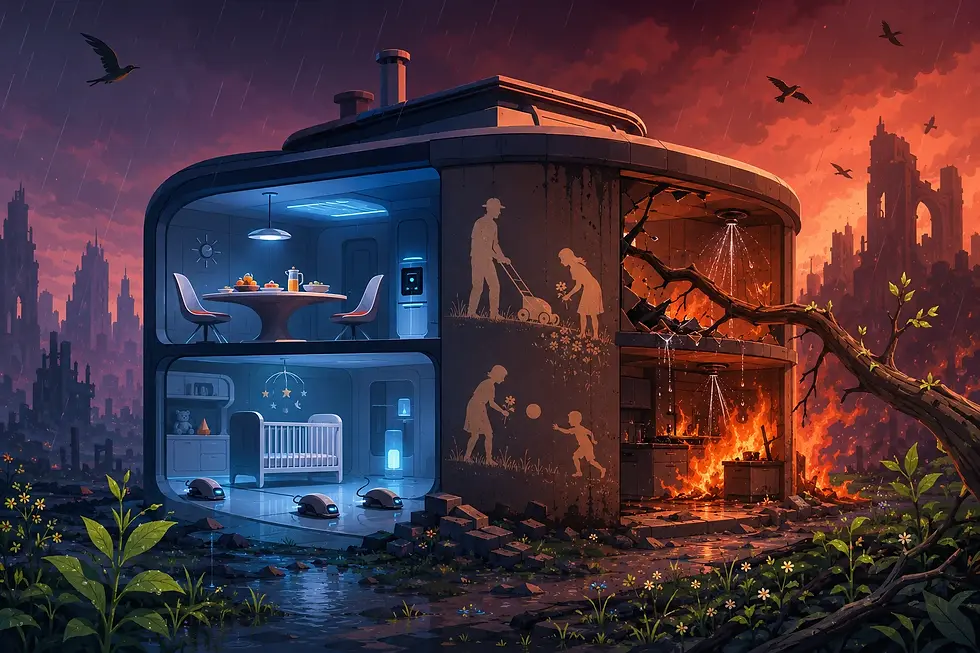
The Scorched Silhouette Wall | The radioactive ruin of the city is revealed, marked by pale outlines of a family vaporised mid-action. |
Senseless Maintenance | Mechanical mice clean the rooms and automated sprinklers wash the scorched facade on schedule. |
The Dog's Agony and Disposal | The emaciated family dog returns, collapses from radiation sickness, and is incinerated as rubbish. |
Simulated Twilight Leisure | Bridge tables unfold, drinks appear, and animated nursery walls project colourful illusions to an empty room. |
Recitation of Teasdale's Verse | The house recites Sara Teasdale's poem on nature's complete indifference to human extinction. |
The Accidental Conflagration | A fallen bough breaks a kitchen window, igniting cleaning solvent across the stove. |
The Mechanical Counter-Attack | Water jets, chemical sprays, and frantic mechanical voices struggle unsuccessfully to contain the blaze. |
Collapse and the Solitary Monologue | The house crashes into ruins, leaving a solitary standing wall that endlessly chants the date to the dawn. |
SECTION 4 — Narrative Beat-wise Meaning
Beat 1: The Automated Dawn
Text Reference: The voice-clock announces the time and calls an empty home to rise.
The narrative commences with mechanical precision addressing a profound silence, creating an immediate sense of uncanny displacement. The clock's cheerful commands underscore an inflexible programme operating entirely oblivious to human absence. Bradbury introduces the central existential irony: technology continues its scheduled obedience even after its creators have vanished.
Beat 2: The Untouched Breakfast
Text Reference: The kitchen prepares eggs, toast, bacon, coffee, and milk with flawless efficiency.
The automated production of food highlights the tragic absurdity of mechanical routine divorced from human purpose. Perfect culinary efficiency transforms into sheer waste when there is no living throat to nourish. Bradbury underscores that technical sophistication without living consciousness degenerates into meaningless repetition.
Beat 3: The Scorched Silhouette Wall
Text Reference: Pale outlines on the charred west wall depict a family frozen in ordinary tasks.
The permanent white outlines of a father mowing, a mother picking flowers, and children playing ball memorialise the precise second of nuclear annihilation. By withholding graphic depictions of carnage, Bradbury evokes the horror of sudden devastation through domestic relics. The contrast between this burnt monument and the cheerful interior exposes the fatal contradiction of a civilisation that perfected domestic ease while engineering total destruction.
Beat 4: Senseless Maintenance
Text Reference: Robotic mice emerge to sweep dust while exterior sprinklers douse the garden.
The house continues its protective and sanitary functions with fastidious care, behaving like a temple where mechanical attendants tend to vanished gods. This meticulous upkeep demonstrates how automation preserves the outer shell of civilization without preserving any of its human soul. The machines' unyielding dedication reveals their complete inability to comprehend catastrophe.
Beat 5: The Dog's Agony and Disposal
Text Reference: The dying dog enters frantically, collapses from radiation, and is swept into the incinerator.
The return of the diseased dog injects organic vulnerability, memory, and emotional longing into a cold mechanical environment. While the house recognises the animal's whine to open the door, it possesses no programmed mechanism for empathy, comfort, or medical care. The swift, robotic clearance of the dog's carcass into the incinerator illustrates technology's chilling indifference to biological suffering.
Beat 6: Simulated Twilight Leisure
Text Reference: Nursery walls generate luminous beasts while tables prepare cards and refreshments.
The automated nursery manufactures synthetic wonder and leisure for children who will never return to enjoy them. This spectacle of artificially reproduced imagination exposes the hollowness of virtual entertainment in the absence of human wonder. Bradbury illustrates that abundance, comfort, and play derive their entire value from conscious participation.
Beat 7: Recitation of Teasdale's Verse
Text Reference: The ceiling voice selects and recites Sara Teasdale's poem on war.
The spoken verse provides the philosophical core of the text, articulating how the natural world continues to flourish entirely unaware of human self-destruction. The mechanical voice delivers this prophetic truth to an empty room, deepening the dramatic irony. It sets the stage for the coming disaster by highlighting the vast gulf between natural renewal and artificial permanence.
Beat 8: The Accidental Conflagration
Text Reference: A tree branch crashes through the window, toppling flammable solvent onto the stove.
The catastrophe originates not from warfare, but from an uncalculated natural accident penetrating the sealed domestic sanctuary. The falling bough and rising wind represent the uncontrolled, amoral forces of the natural world intruding upon human artifice. The scene demonstrates that even the most advanced defensive engineering remains susceptible to random physical chance.
Beat 9: The Mechanical Counter-Attack
Text Reference: Mechanical voices scream alarms as water pipes and chemical foams battle the flames.
The personified struggle of the house resembles the desperate, panicked agony of a dying organism fighting for survival. Yet the automated defences rapidly collapse because precious water supplies were squandered on routine cleaning and maintenance earlier in the day. The house's complex, rigid circuitry cannot adapt its priorities to combat an unprecedented crisis.
Beat 10: Collapse and the Solitary Monologue
Text Reference: The structure collapses into smoking ash while a single wall repeats the new date.
The dawn breaks over a scene of complete ruin, confirming the natural world's eternal, unhurried continuity. Amid the rubble, a single intact voice-box continues its chronological chant to an empty dawn. This final image encapsulates the tragic futility of technological programming surviving into a world where it has neither audience nor meaning.
SECTION 5 — Key Characters
The Automated House: The central narrative presence and technological protagonist of the story. Endowed with personified anxiety, fastidiousness, and frantic self-defence, the house functions as a domestic fortress executing its programming with ritualistic perfection. However, it lacks genuine consciousness, moral agency, or adaptive judgment. It maintains the illusion of domestic stability until an accidental blaze exposes its ultimate fragility and dependence on finite physical resources.
The Absent Family: The vaporised McClellan family—father, mother, son, and daughter—functions as a collective presence defined entirely by absence. Preserved only as pale silhouettes on a radioactive wall and as scheduled entries in the clock's memory, their vanished lives represent ordinary human domesticity obliterated by nuclear warfare. Their presence serves as a haunting reminder of the civilization that built the home.
The Family Dog: The sole living, organic entity in the narrative, serving as a tragic foil to the unfeeling machines. Emaciated, diseased, and driven by memory and grief, it experiences genuine emotional and physical torment. Its unceremonious disposal by the robotic mice highlights the complete absence of compassion within automated systems.
Minor Presences: The fire acts as an amoral, elemental adversary that breaches the domestic enclosure, while the cleaning mice and voice-clock embody the relentless, unthinking execution of programmed domestic order.
SECTION 6 — Central Theme and Tone
6A. Theme
"There Will Come Soft Rains" is fundamentally a warning against technological hubris, demonstrating that advancing scientific ingenuity without moral wisdom leads inevitably to human self-annihilation. Bradbury illustrates that while human machines may temporarily outlast their creators, nature remains entirely indifferent to human civilization and will reclaim the earth without pause.
6B. Tone / Atmosphere
The narrative atmosphere opens with an eerie, clinical cheerfulness that gradually deepens into profound melancholy as the extent of nuclear ruin is revealed. During the climactic battle between fire and machinery, the tone surges into violent, nightmarish panic before resolving into a desolate, hauntingly quiet dawn.
6C. Secondary Idea
The story exposes the stark contrast between mechanical efficiency and authentic human judgment, revealing that automated systems can mimic domestic order but can never generate genuine empathy, adaptability, or moral purpose.
SECTION 7 — Vocabulary in Context
Word / Phrase | Meaning in This Context | Where It Appears |
Obliterated | Completely destroyed and wiped out of existence | Description of the surrounding ruined city |
Radioactive | Emitting hazardous, lingering nuclear radiation | The glow emanating from the demolished city at night |
Silhouette | A distinct outline of a human figure left on a surface | The charred impressions of the family on the west wall |
Regimented | Strictly organised, scheduled, and controlled by routine | The automated timetable of the household system |
Incinerator | A specialised furnace designed for burning refuse and waste | The disposal chamber into which the dead dog is carried |
Paranoia | An unreasonable, obsessive fear of outside intrusion or danger | The hypersensitive security measures of the automated house |
Senselessly | Lacking all practical meaning, purpose, or reason | The continued ritual of domestic tasks in an empty house |
Sublime | Awe-inspiring and grand in sensory or aesthetic impact | The artificial landscapes projected upon the nursery walls |
Capillaries | Fine, intricate branching tubes carrying liquid through a system | The internal plumbing network supplying water to the walls |
Reinforcements | Supplementary mechanisms or resources deployed to resist assault | The chemical sprays and secondary water pumps fighting the fire |
SECTION 8 — Key Literary & Narrative Techniques
Technique | Example | Effect | Beat Reference |
Personification |
| Endows mechanical failure with visceral, biological agony, making the building's demise resemble a living creature's death. | Beat 9: The Mechanical Counter-Attack |
Situational Irony |
| Highlights the absurdity of flawless technological efficiency performing its duties in the complete absence of human consumers. | Beat 2: The Untouched Breakfast |
Symbolism |
| Freezes ordinary domestic life at the precise instant of nuclear destruction, turning the exterior wall into an accidental war monument. | Beat 3: The Scorched Silhouette Wall |
Allusion & Intertextuality |
| Integrates Sara Teasdale's lyric poem to articulate nature's total apathy toward human warfare and extinction. | Beat 7: Recitation of Teasdale's Verse |
SECTION 9 — Structured Long-Answer Practice
Question (i) [5 Marks]
Explain how the morning routines of the automated house establish both its engineering precision and its existential futility. Discuss with reference to:
(a) the unyielding execution of programmed tasks
(b) the complete absence of human beneficiaries
Model Answer:
The opening sequence establishes the automated house as a marvel of mechanical coordination that operates with flawless chronological discipline. The voice-clock announces waking hours, the kitchen prepares an elaborate breakfast of eggs, toast, and coffee, and small robotic cleaning mice scurry across the floors to remove dust. Every system functions precisely according to its programmed timetable. However, because nuclear warfare has obliterated the family, this clockwork efficiency becomes an absurd and wasteful ritual. Steaming food goes cold, untouched cups are scraped into the incinerator, and baths are drawn for phantom occupants. Bradbury demonstrates that technology divorced from human purpose loses all meaning, transforming domestic conveniences into an eerie, hollow performance of life.
Question (ii) [5 Marks]
Analyse the significance of the scorched silhouettes on the west wall. Incorporate:
(a) the ordinary domestic activities depicted in the outlines
(b) the sudden, catastrophic nature of the nuclear flash
Model Answer:
The charred west wall provides the narrative's most poignant visual evidence of the McClellan family's instantaneous destruction. Set against a scorched surface blackened by radioactive fire, white silhouettes capture a man mowing a lawn, a woman bending to pick flowers, and two children tossing a ball in mid-air. These outlines freeze a completely ordinary, peaceful domestic afternoon at the exact fraction of a second when nuclear annihilation struck. Rather than detailing graphic devastation, Bradbury uses this photographic negative to emphasise the terrible fragility of everyday human life. The silhouettes stand as an accidental memorial, contrasting the tragic vulnerability of biological life with the unfeeling durability of the automated house that survived them.
Question (iii) [10 Marks] — Whole-Story Question (Internal Choice)
Option (a)
"The automated house functions as the technological protagonist of the story, yet it remains completely devoid of true human consciousness." Evaluate this assessment with reference to the entire text.
Model Answer:
Ray Bradbury positions the automated house as the central presence of the narrative, assigning it the structural role normally occupied by a living protagonist. The plot charts the house's actions across twenty-four hours, detailing its morning alarms, kitchen duties, entertainment systems, and final defensive battle against fire. Through persistent personification, the narrator endows the structure with traits resembling personality: it exhibits an anxious paranoia toward strange animals, sings cheerful announcements, cleans with manic pride, and screams in terror as flames consume its electrical nerves. This dynamic portrayal generates narrative tension and even reader empathy as the house fights desperately to preserve its internal order.
Nevertheless, the house remains fundamentally a complex machine bound strictly to pre-set programming rather than a conscious, feeling entity. It cannot adapt to the reality of the nuclear holocaust or recognise that its masters are dead. It treats the agonizing death of the family dog not with compassion, but as a routine sanitation problem, promptly incinerating the remains. Its voice-boxes deliver cheerful weather updates, card invitations, and bedtime poetry into empty rooms without understanding their significance. When the fire breaks out, the house's responses are rigid and resource-blind; having exhausted its water reserves on routine garden sprinklers, its defensive network collapses. The house is thus a tragic symbol of human ingenuity: an elaborate, unthinking monument that mechanically preserves the forms of civilization without possessing the spark of consciousness necessary to understand them.
OR
Option (b)
Discuss how Bradbury uses Sara Teasdale's poem and the final conflagration to illustrate nature's ultimate triumph over human technology.
Model Answer:
Sara Teasdale's 1920 anti-war lyric, recited by the automated ceiling voice, establishes the philosophical foundation of Bradbury's post-apocalyptic vision. The poem imagines birds, frogs, wild plum trees, and the spring season continuing their cycles completely untroubled by mankind's self-inflicted extinction. In the context of the story, this poetic prophecy has become reality: nuclear weapons have wiped out humanity, while the natural world—represented by rain, wind, and the radioactive dawn—persists without mourning the loss. The mechanical house initially appears to defy this premise by preserving human routines inside an artificial enclosure, but the text gradually demonstrates that technology cannot achieve nature's self-renewing permanence.
The climactic fire dismantles the illusion of technological mastery. Significantly, the fire is ignited not by an act of war, but by a random natural occurrence when a tree branch crashes through the window and topples cleaning solvent onto the stove. As wind feeds the flames, nature reclaims the artificial space. The house mounts a frantic defense, yet its finite resources—depleted by senseless domestic routines—quickly fail. In the morning light, the ruined house lies as a smoking heap of rubble, while the sun rises faithfully to inaugurate a new day. Only a lone wall remains chanting the date to an indifferent landscape. Through this elemental clash, Bradbury confirms Teasdale's theme: human technology, no matter how sophisticated, is a fragile construct that nature easily outlasts and consumes.
SECTION 10 — Personal Response Question
Q. What does "There Will Come Soft Rains" invite you to think, question, or feel about modern society's increasing reliance on automated technology and artificial intelligence? Explain your response with reference to the story.
Answer:
Bradbury's narrative prompts a sobering reflection on the danger of confusing technological advancement with true human wisdom. The automated house represents an extraordinary triumph of engineering, capable of anticipating every physical convenience and domestic need. Yet this advanced home stands completely powerless in the face of human catastrophe, continuing its sterile routines inside a radioactive wasteland. This haunting juxtaposition invites the reader to question whether our growing reliance on automated systems diminishes our moral vigilance. When a society devotes immense intellect to crafting domestic comforts while simultaneously building tools of planetary destruction, technological sophistication becomes a symptom of moral blindness rather than genuine progress. The story ultimately reminds us that machines cannot supply the ethical restraint or empathy needed to preserve humanity.
CLOSING — Looking for Deeper Exam Mastery?
These blog notes provide a focused overview of the narrative progression, themes, and literary techniques in Ray Bradbury's "There Will Come Soft Rains." For students seeking complete examination mastery, the comprehensive BhashaLab PDF Study Notes offer deeper critical appreciation, a second full 20-mark structured practice set, Section A objective question banks, and verified score-boosting examiner tips.


