

4.3. Around the World in Eighty Days - Class 12-English yuvakbharati
Updated: Mar 6
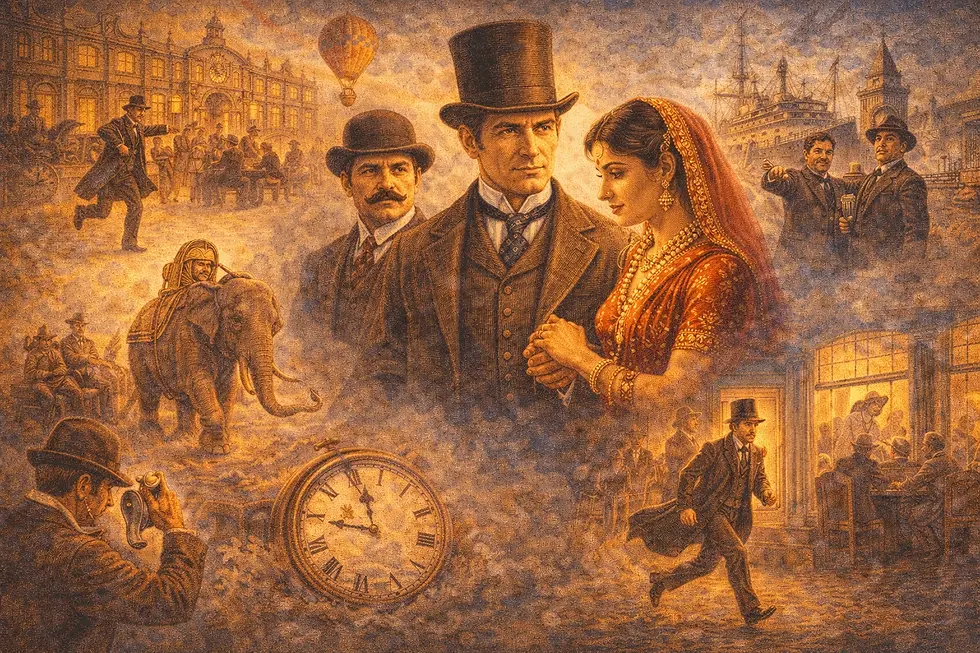
Author: Jules Gabriel Verne | Genre: Adventure Novel
1. Comprehensive Glossary
Word | Meaning (English) | Meaning (Hindi) |
Heinous | Very wicked or deeply criminal | घृणित / अति दुष्ट |
Portico | A roof supported by columns at an entrance | बरामदा / ड्योढ़ी |
Knave | A dishonest or unscrupulous man | धूर्त व्यक्ति |
Precision | The quality of being exact and accurate | परिशुद्धता |
Domicile | A person's permanent place of residence | निवास स्थान |
Tranquility | The quality or state of being calm and peaceful | शांति |
Blundering | Making a stupid or careless mistake | बड़ी भूल |
Expedient | A means of attaining an end | उपाय / साधन |
Imperturbable | Not easily upset or worried; calm | शांत / अविचलित |
Remorse | Deep regret or guilt for a wrong committed | पश्चाताप |
Pensive | Engaged in deep or serious thought | विचारमग्न |
Rectitude | Morally correct behavior or thinking | सदाचार / इंसाफ |
Zenith | The highest point reached by an object | आकाश का शिखर |
Fastidious | Very attentive to and concerned about accuracy | बारीकी पर ध्यान देने वाला |
Pecuniary | Relating to or consisting of money | धन संबंधी |
2. Introduction & Summary
Ice Breakers:
Discuss how modern technology (GPS, high-speed travel) has changed our perception of traveling "around the world" compared to the 19th century.
Reflect on whether honor and keeping one's word is more valuable than winning a large sum of money.
Summary: Phileas Fogg, a precise and solitary Englishman, wagers £20,000 at the Reform Club that he can travel around the world in eighty days. Accompanied by his loyal servant Passepartout, he faces numerous obstacles, including being pursued by Detective Fix, who suspects Fogg of being a bank robber. Along the way, Fogg rescues Aouda, an Indian princess, who joins them.
Upon arriving in Liverpool, Fogg is arrested by Fix, causing him to arrive in London apparently five minutes late. Believing he has lost his fortune and honor, Fogg is consoled by Aouda, who proposes marriage. However, while arranging the wedding, Passepartout discovers that by traveling eastward across the International Date Line, the group gained a full day. Fogg rushes to the Reform Club, arriving at the final second to win the wager. Ultimately, Fogg gains more than money; he finds true happiness and human connection.
3. HSC Board Activity Sheet Pattern (Prose Section)
A1. Global Understanding (2 Marks)
Set 1: True or False
Phileas Fogg was primarily motivated by the money from the wager. (False)
Detective Fix arrested Fogg at Liverpool. (True)
Aouda proposed marriage to Phileas Fogg. (True)
The group traveled westward to gain a day. (False)
Fogg divided his remaining money between Passepartout and Fix. (True)
Set 2: Arrange in Sequence
Fix releases Fogg after the real robber is caught.
Passepartout discovers it is Saturday, not Sunday.
Aouda proposes to Fogg in Saville Row.
Fogg arrives at the Reform Club at the 57th second.
Fogg is imprisoned in the Custom House at Liverpool.
Answer: 5 → 1 → 3 → 2 → 4
Set 3: Complete the Web
Question: Identify the major places Fogg visited during his tour.
Answer: Suez, Bombay (Mumbai), Calcutta (Kolkata), Hong Kong, Yokohama, San Francisco, New York, Liverpool, London.
Set 4: Multiple Choice (Select appropriate reason)
Question: Why did Phileas Fogg gain a day?
(a) He used fast locomotives.
(b) He traveled constantly eastward.
(c) He ignored time zones.
(d) The International Date Line moved.
Answer: (b) He traveled constantly eastward.
Set 5: Correct the Sentences
Passepartout was happy when Fix arrested his master. (Correct: Passepartout was furious and would have attacked Fix.)
Fogg reached London exactly on time in the special train. (Correct: He arrived ten minutes before nine, thinking he was late.)
A2. Complex Factual (2 Marks)
Question: How did Phileas Fogg react to his imprisonment at the Custom House?
Answer: Fogg remained outwardly calm and motionless on a wooden bench, showing no apparent anger. He carefully placed his watch on the table to observe the hands, maintaining his "impassibility" despite the ruinous situation.
Question: Explain the cause of Fogg's error regarding the day of his arrival.
Answer: Fogg traveled eastward, toward the sun, crossing 360 degrees. For every degree crossed, he gained four minutes, totaling 24 hours over the entire circumference of the earth. While he saw the sun pass the meridian 80 times, only 79 days had passed in London.
Question: Describe the scene at the Reform Club as the deadline approached.
Answer: A massive crowd gathered outside, while the five antagonists waited inside the saloon in intense anxiety. They suspended their card game to count the final seconds by the pendulum's beat, believing Fogg had surely lost until he appeared at the 57th second.
Question: Why did Passepartout feel tortured by remorse after Fogg’s arrest?
Answer: He blamed himself for not warning Fogg about Fix’s true purpose. He felt that if he had betrayed Fix's project earlier, Fogg could have proven his innocence and avoided the fatal arrest at Liverpool.
Question: What was the final resolution of the money Fogg had left?
Answer: Fogg had only £1,000 left after his massive travel expenses. He divided this sum between Passepartout and Fix. However, he deducted the cost of the gas that burned in Passepartout's room for 1,920 hours during their absence.
A3. Inference / Interpretation / Analysis (2 Marks)
Question: "Phileas Fogg's motivation has little to do with money." Interpret this statement.
Answer: Fogg spent nearly £19,000 of his potential £20,000 fortune on travel expenses. His primary goal was to preserve his honor and prove his worth to the Reform Club members, demonstrating that his mathematical precision could overcome any obstacle.
Question: Analyze the significance of the gas burner left on in Saville Row.
Answer: The burner, which remained lit for the entire 80 days, symbolizes Passepartout’s initial haste and the cost of human error. Fogg's decision to deduct the cost from Passepartout’s share highlights his obsession with regularity and "mathematical" justice.
Question: How does the character of Aouda contribute to Fogg’s transformation?
Answer: Initially solitary and indifferent to others, Fogg learns to appreciate human connection through Aouda. Her proposal of marriage when he is "ruined" proves her sincerity, leading Fogg to confess his love and find true happiness.
Question: Interpret the role of Detective Fix as both an antagonist and a recipient of Fogg's mercy.
Answer: Fix creates the primary external conflict by placing obstacles in Fogg's path and eventually arresting him. However, because Fix was "only doing his duty," Fogg cherishes no grudge and even rewards him at the end, showing Fogg's cold but fair sense of justice.
Question: Why does the author describe Fogg as a "machine" even in his moment of passion?
Answer: When Fogg knocks Fix down after being released, he does so with the "precision of a machine". This illustrates that Fogg’s control and exactitude are so deeply ingrained that even his rare outbursts of emotion are executed with mathematical efficiency.
A4. Personal Response (2 Marks)
Question: Do you agree that "Time" is the most important feature of this novel? Give your opinion.
Answer: Yes, I agree. The entire plot revolves around beating the clock and traveling through time zones. The final twist—the gain of 24 hours—shows that while humans try to organize and calculate time precisely, we are ultimately at the mercy of its natural laws.
Question: If you were Phileas Fogg, would you have forgiven Detective Fix? Why?
Answer: In my opinion, I would forgive him just as Fogg did. Fix believed he was performing a legal duty to catch a criminal. Holding a grudge would be unproductive; rewarding him shows a higher level of moral character and a focus on the successful completion of the journey.
Question: What is your takeaway from Fogg's willingness to spend his entire fortune to win a bet?
Answer: I think it shows that some things, like self-respect and honor, are far more valuable than material wealth. Fogg risked everything to prove a point, suggesting that the journey and the challenge are more rewarding than the actual prize.
Question: Do you believe Aouda's marriage proposal was a bold move for her time?
Answer: It was extremely bold. In that era, women rarely proposed, but her action was driven by deep gratitude and a desire to support Fogg in his moment of ruin. It shows her strength of character and her ability to "dare all" for love.
Question: "Happiness is the only thing Fogg truly gained." Do you agree?
Answer: I completely agree. While he won the money, he spent most of it on the trip. The true gain was the shift from a solitary life to one shared with a "charming woman" and a loyal friend, which made him the "happiest of men".
6. Literary Genre: Novel (Detailed Analysis)
Plot Summary
The Wager: Phileas Fogg bets £20,000 at the Reform Club that he can circumnavigate the globe in 80 days.
The Pursuit: Detective Fix follows Fogg, believing he is a bank robber, while Passepartout tries to aid his master.
The Rescue: In India, Fogg saves Aouda from a terrible fate; she joins the journey.
The Delay: Upon reaching Liverpool, Fix arrests Fogg, causing him to seemingly miss the deadline in London.
The Twist: Aouda proposes marriage; Passepartout realizes they gained a day by traveling east.
The Victory: Fogg reaches the Reform Club with seconds to spare, winning the bet and marrying Aouda.
Character Sketches
Phileas Fogg: A "precise," "mathematical," and "eccentric" gentleman. He values honor over money and displays "marvellous qualities of coolness" under pressure.
Passepartout: Fogg’s loyal, "faithful," and sometimes "crazy" French servant. His ingenuity helps the group, though his forgetfulness (like the gas burner) creates minor conflicts.
Aouda: A "charming," "beautiful," and "noble" woman rescued by Fogg. She is "sincere" and "firm," ultimately choosing to share Fogg’s "misery" before discovering he is still rich.
Detective Fix: A diligent but "mistaken" detective. He represents the obstacles of duty, eventually apologizing for his "unfortunate resemblance" mistake.
Setting
London (Reform Club/Saville Row): The starting and ending points, representing order, society, and the source of Fogg's challenge.
The Global Route: A fast-paced journey through exotic lands (India, Japan, America) using every means of transport from elephants to sledges.
The Custom House, Liverpool: A place of temporary "ruin" and imprisonment that sets the stage for the final climax.
Theme
Time: The central "fickle" force that works both for and against the characters.
Honor vs. Riches: Fogg’s journey proves that fulfilling a goal and maintaining one's reputation is more important than pecuniary gain.
Human Connection: The shift from Fogg's solitary existence to a life of love and friendship.
Brainstorming Activities (2 Marks Each)
Describe/Explain (5 Questions)
Describe Fogg’s physical state while waiting in the Custom House.
Answer: Fogg sat motionless and calm on a wooden bench, appearing without anger despite being ruined. His only action was walking slowly around the room once to check for exits and carefully watching his watch's hands.
Explain the significance of the Reform Club members' anxiety.
Answer: Their anxiety reflects the high stakes of the wager and the public's intense interest in Fogg’s "eccentric" journey. It shows that Fogg's reputation for punctuality made them doubt his failure until the very last minute.
Describe the means of transport used by Fogg.
Answer: Fogg employed every available means of conveyance, including steamers, railways, carriages, yachts, trading-vessels, sledges, and even elephants. This variety highlights the adventurous and unpredictable nature of his journey.
Explain why Fogg gave part of his winnings to Fix.
Answer: Fogg "cherished no grudge" against Fix because he recognized that the detective had only been doing his duty based on a "mistaken" identity. This act illustrates Fogg's cold but noble sense of fairness.
Describe the change in public opinion about Fogg.
Answer: Once the real bank robber, James Strand, was arrested in Edinburgh, Fogg’s image shifted from a criminal on the run to an "honourable gentleman" mathematically pursuing a feat. Interest in the "Phileas Fogg bonds" was instantly revived.
Compare/Contrast (5 Questions)
Contrast Fogg’s behavior when he thinks he lost vs. when he realizes he won.
Answer: When he thinks he lost, Fogg is "tranquil and phlegmatic," quietly putting his affairs in order and meditating in solitude. When he realizes he won, he is "kidnapped" by Passepartout’s energy, rushing into a cab to reach the club just in time.
Compare the loyalty of Passepartout and Aouda.
Answer: Both are intensely loyal; Passepartout watches his master "like a faithful dog" to prevent suicide , while Aouda is willing to marry a "ruined" man to share his misery and offer him a "kinswoman and friend".
Contrast the mood in Saville Row with the mood in Pall Mall on Saturday evening.
Answer: Saville Row was "as if uninhabited," dark and silent as Fogg brooded over his loss. In contrast, Pall Mall was a "multitude of brokers" and excited crowds, rising to a "highest pitch" of excitement as the deadline neared.
Compare Fogg’s "precision" with the "fickle" nature of time.
Answer: Fogg is an "obsessive organizer" and "master calculator" who tries to control every second. However, the "fickle" nature of time nearly foils his plans through unexpected delays, though it ultimately rewards his eastward journey with an extra day.
Contrast the reactions of Fogg and Passepartout to the arrest in Liverpool.
Answer: Fogg remains "stern" and "motionless," appearing to accept his fate. Passepartout is emotionally devastated, "weeping till he was blind" and feeling like "blowing his brains out" due to his perceived role in the disaster.
Illustrate/Interpret (5 Questions)
Illustrate the concept of "mathematical regularity" in the club's saloon.
Answer: The five members count the seconds along with the "pendulum's beat". This illustrates how Fogg's entire wager—and the members' belief in it—is built on strict, quantifiable units of time.
Interpret Fogg's statement: "I blame no one. Go!"
Answer: This statement, made to a remorseful Passepartout, illustrates Fogg's extreme "calmness" and his philosophy that what is done cannot be undone. He accepts the consequences of his journey without wasting energy on anger or blame.
Illustrate the "sudden twist" in the climax.
Answer: The twist occurs when Passepartout discovers it is Saturday, not Sunday. This is possible only because Fogg "unconsciously gained" twenty-four hours by traveling eastward across 360 degrees of the earth's circumference.
Interpret the role of the Reverend Samuel Wilson.
Answer: Though a minor character, the Reverend is the catalyst for the discovery of the lost day. It is only by sending Passepartout to engage him for the wedding that the group learns their true arrival time.
Illustrate Fogg’s "phlegmatic" nature during the proposal.
Answer: Even when Aouda proposes, Fogg at first astonished, then "penetrated" by her sincerity, answers her simply with "I love you" and immediately summons Passepartout to resume the "mathematical" task of arranging a wedding.
Narrate/Justify (5 Questions)
Narrate Passepartout’s discovery of the "error of a day."
Answer: Sent to engage a clergyman for a Monday wedding, Passepartout finds the Reverend is not available because it is actually Saturday. He realizes they arrived twenty-four hours early and drags his master to the Reform Club with only ten minutes left.
Justify the author’s claim that Fogg gained "nothing but a charming woman."
Answer: Fogg spent almost his entire fortune on the journey, leaving him with very little pecuniary gain. However, the author justifies this "nothing" by stating that she made him the "happiest of men," which is more valuable than any wager.
Narrate Fogg’s confrontation with Detective Fix.
Answer: When Fix finally announces that Fogg is free due to the real robber's arrest, Fogg looks him steadily in the face. With the "only rapid motion" of his life, Fogg knocks Fix down with "the precision of a machine".
Justify the use of London as the primary setting.
Answer: London, as the seat of the British Empire and home to the Reform Club, represents the societal standards and "regularity" that Fogg embodies. The return to London is necessary to resolve the wager and themes of honor.
Narrate the final moments before Fogg enters the Reform Club.
Answer: The club members count the seconds. At the 55th second, they hear a loud cry from the street. At the 57th second, the door opens, and at the 60th, Fogg appears and calmly announces, "Here I am, gentlemen!".
About BhashaLab
BhashaLab is a dynamic platform dedicated to the exploration and mastery of languages - operating both online and offline. Aligned with the National Education Policy (NEP) 2020 and the National Credit Framework (NCrF), we offer language education that emphasizes measurable learning outcomes and recognized, transferable credits.
We offer:
NEP alligned offline language courses for degree colleges - English, Sanskrit, Marathi and Hindi
NEP alligned offline language courses for schools - English, Sanskrit, Marathi and Hindi
Std VIII, IX and X - English and Sanskrit Curriculum Tuitions - All boards
International English Olympiad Tuitions - All classes
Basic and Advanced English Grammar - Offline and Online - Class 3 and above
English Communication Skills for working professionals, adults and students - Offline and Online
Contact: +91 86577 20901, +91 97021 12044
Mail: info@bhashalab.com
Website: www.bhashalab.com


