4.4. The Sign of Four - Class 12 -English yuvakbharati
Updated: Mar 6

Author: Sir Arthur Conan Doyle | Genre: Novel
1. Comprehensive Glossary
Word | Meaning (English) | Meaning (Hindi) |
Prolific | Producing a large amount of work | बहुप्रज / उपजाऊ |
Whisked | Moved quickly and suddenly | तेज़ी से ले जाना |
Eccentric | Unconventional and slightly strange | विलक्षण / सनकी |
Creosote | A dark brown oil used for preserving wood | लकड़ी पर लेप करने का तेल |
Pygmy | A member of certain peoples of very short stature | बौना |
Emissary | A person sent on a special mission | दूत / संदेशवाहक |
Penal | Relating to the punishment of offenders | दंडात्मक |
Benefactor | A person who gives money or help | शुभचिंतक / उपकारी |
Chaplet | A string of beads or a garland | माला |
Vacillation | Indecision or wavering | हिचकिचाहट |
Pensively | Reflecting deeply or seriously | विचारमग्न होकर |
Incongruous | Out of place or inappropriate | बेमेल / अनुपयुक्त |
Khitmutgar | A male servant | खिदमतगार / सेवक |
Labyrinth | A complicated network of passages; a maze | भूलभुलैया |
Obtuse | Slow to understand | मंदबुद्धि |
2. Introduction & Summary
Ice Breakers:
Discuss the importance of friendship and trust when facing a dangerous or mysterious situation.
How do you think sudden, unexplained wealth might change a person’s life or character?
Summary:
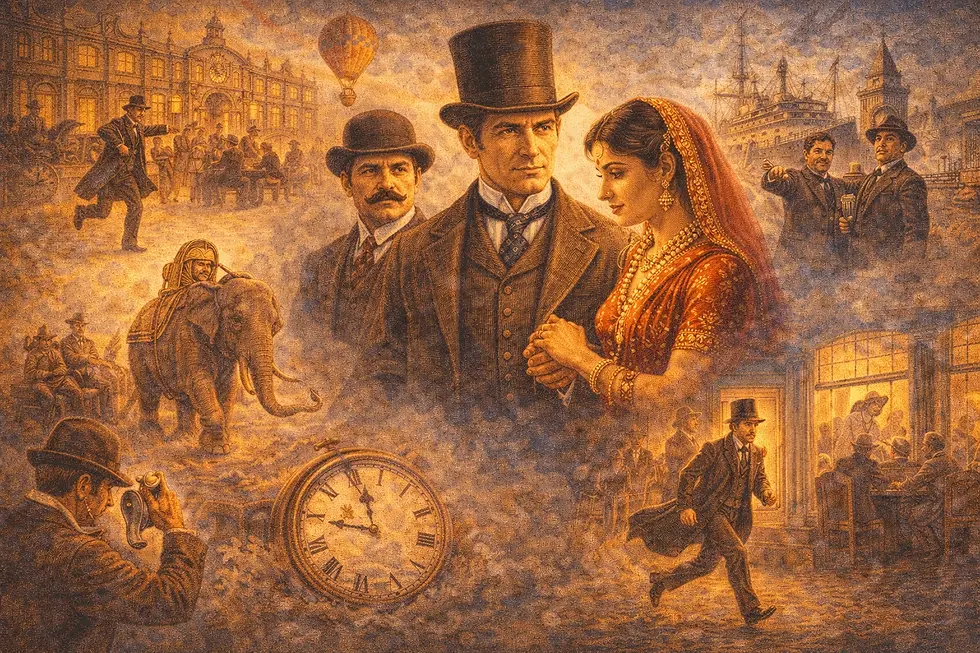
The Sign of Four is a complex detective novel featuring Sherlock Holmes and Dr. Watson. The story begins when Mary Morstan visits Baker Street seeking help regarding her father's disappearance ten years prior and a mysterious annual gift of rare pearls. The mystery deepens when she receives a letter from an "unknown friend" requesting a meeting at the Lyceum Theatre.
The trio is led to Thaddeus Sholto, who reveals that Mary is a partial heir to the Agra treasure, which his father, Major Sholto, had brought from India. The plot involves a secret pact made in India between four convicts ("The Four") and two guards. Following the murder of Thaddeus's brother, Bartholomew, Holmes uses his deductive skills to track the killers—Jonathan Small and his companion Tonga—through the streets of London and along the River Thames.
Ultimately, Small is captured, but the treasure is lost to the river. The novel explores themes of the corrupting nature of wealth, imperial history, and romance, concluding with Dr. Watson proposing to Mary Morstan.
6. Literary Genre: Novel (Detailed Analysis)
Plot: Sequence of Events
The Visit: Mary Morstan arrives at Baker Street with a mystery concerning her father's disappearance and annual pearls.
The Meeting: Holmes, Watson, and Mary meet Thaddeus Sholto, who explains the Agra treasure and his father's death.
The Murder: They find Bartholomew Sholto dead by a poisoned thorn; the Agra treasure is missing.
The Pursuit: Holmes utilizes "Toby" the dog and the Baker Street Irregulars to track the steam launch Aurora.
The Capture: A high-speed chase on the Thames leads to Tonga's death and Jonathan Small's arrest.
The Confession: Small reveals the history of the "Sign of Four" pact in India and how Sholto betrayed them.
The Conclusion: The treasure is dumped in the river; Watson and Mary decide to marry.
Character Sketches
Sherlock Holmes: A brilliant, "calculating-machine" who prioritizes logic over emotion. He is observant, noticing details in handwriting and paper manufacture.
Dr. John Watson: The empathetic narrator and former army surgeon. He is sensitive to Mary's charm and struggles with his feelings for her due to her potential wealth.
Mary Morstan: A composed, "refined" young woman working as a governess. Despite her "limited means," she maintains great self-control throughout the ordeal.
Jonathan Small: A vengeful but loyal man with a wooden leg. He feels a sense of entitlement to the treasure based on a murderous pact made in India.
Setting
London: Set in late 19th-century London, moving from the comfort of Baker Street to the foggy, "forbidding" neighborhoods of South London.
India/Andaman Islands: The backstory is rooted in the Indian Rebellion of 1857 and a penal colony, providing a dark, exotic origin for the mystery.
Theme
The Evil of Wealth: The Agra treasure brings tragedy to everyone who touches it, causing murders, paranoia, and life imprisonment.
Justice and Compensation: Thaddeus Sholto seeks to rectify the "wrong" done to Mary by sharing the treasure.
Brainstorming Activities (Practice Sets)
Describe/Explain (5 Questions)
Describe Mary Morstan's appearance as noted by Watson.
Answer: Watson describes her as a small, dainty young lady dressed in a "sombre grayish beige" costume. Although she wasn't a classic beauty, her expression was "sweet and amiable" and her blue eyes were "spiritual and sympathetic".
Explain why Holmes is considered "inhuman" by Watson.
Answer: Watson calls him a "calculating-machine" because Holmes ignores the personal qualities of a client. Holmes believes emotional qualities are "antagonistic to clear reasoning" and views clients as mere "factors in a problem".
Describe the contents of Captain Morstan's luggage.
Answer: It contained clothes, books, and a considerable number of "curiosities from the Andaman Islands". There was no clue regarding his disappearance within the items.
Explain the significance of the "Sign of Four" note.
Answer: It refers to a pact between Jonathan Small and three Sikh guards(Mahomet Singh, Abdullah Khan, and Dost Akbar). Small left the note on Sholto's body as a mark of vengeance.
Describe the atmosphere of London as the trio heads to the meeting.
Answer: The evening is "dreary" with a "dense drizzly fog". The streets are muddy, and the lamps appear as "misty splotches" in the vaporous air, creating an eerie, ghost-like feeling.
Compare/Contrast (5 Questions)
Contrast Holmes's and Watson's reactions to Mary Morstan.
Answer: Watson is immediately attracted to her "refined nature" and finds her "very attractive". Conversely, Holmes is "languid" and claims he did not even "observe" her as a woman, seeing her only as a "unit" in a case.
Compare the personalities of Thaddeus and Bartholomew Sholto.
Answer: Thaddeus is described as "eccentric" but possesses a conscience, wishing to share the treasure with Mary. Bartholomew is more possessive; he quarrels with Thaddeus and keeps the treasure for himself upon finding it.
Contrast the neighborhood of Baker Street with the Lyceum Theatre's destination.
Answer: Baker Street represents a familiar, professional starting point. Their journey leads them to a "questionable and forbidding neighborhood" with "dull brick houses" and the "tawdry brilliancy of public houses".
Compare Major Sholto and Captain Morstan.
Answer: Both were officers in the Andaman Islands. However, Sholto is depicted as "corrupt" and fearful after betraying his friends for the treasure, while Morstan is the "wronged" victim who died of a heart attack.
Contrast the handwriting of the pearls' sender and Captain Morstan.
Answer: Holmes notes that the sender's hand has "irrepressible Greeke" characters and specific "twirls". When asked if it resembles her father's, Mary states that nothing could be "more unlike".
Illustrate/Interpret (5 Questions)
Illustrate how the Agra treasure is a "curse."
Answer: Nearly everyone involved suffers: the emissary is murdered, Bartholomew is poisoned, Tonga is shot, Small is imprisoned for life, and Major Sholto lives in constant paranoia.
Interpret Holmes's interest in the "Winwood Reade" book.
Answer: Holmes recommends Martyrdom of Man to Watson, calling it a "remarkable" book. This reflects Holmes's intellectual nature and his preference for "daring speculations" over emotional concerns.
Illustrate the "Sign of the Four" diagram found by Mary.
Answer: It is a plan of a building on Indian paper with a red cross and the names of the four conspirators: Small, Singh, Khan, and Akbar.
Interpret the meaning of "The Sahib awaits you."
Answer: Spoken by a servant in "Oriental" dress, it signifies that the trio has reached their destination and that the mysterious host (Thaddeus) is ready to reveal his secrets.
Illustrate Watson's inner conflict regarding Mary Morstan.
Answer: Watson worries that proposing to Mary while she is a potential "heiress" would look like he is after her money. He feels his "weak banking-account" makes him unworthy.
Narrate/Justify (5 Questions)
Narrate the disappearance of Captain Morstan.
Answer: Morstan returned from India in 1878 and telegraphed Mary to meet him at the Langham Hotel. When she arrived, he had gone out and never returned, leaving his luggage behind.
Justify Holmes's use of a disguise in the case.
Answer: After the "Baker Street Irregulars" failed to find the boat Aurora, Holmes went out in disguise to conduct his own search. This justifies his hands-on approach and ability to blend into the city's underbelly.
Narrate how Jonathan Small lost his leg.
Answer: Small was a soldier in India who lost his right leg in a "swimming accident to a crocodile". This physical trait becomes a primary clue for Holmes.
Justify the removal of the Agra treasure at the end of the story.
Answer: The removal of the treasure restores the "status quo". It allows Small to return to prison and enables Watson to propose to Mary without the shadow of her wealth.
Narrate the encounter at the Lyceum Theatre.
Answer: The trio meets a "small, dark, brisk man" at the third pillar. After confirming they are not police, he drives them in a carriage to an unknown destination in South London.
About BhashaLab
BhashaLab is a dynamic platform dedicated to the exploration and mastery of languages - operating both online and offline. Aligned with the National Education Policy (NEP) 2020 and the National Credit Framework (NCrF), we offer language education that emphasizes measurable learning outcomes and recognized, transferable credits.
We offer:
NEP alligned offline language courses for degree colleges - English, Sanskrit, Marathi and Hindi
NEP alligned offline language courses for schools - English, Sanskrit, Marathi and Hindi
Std VIII, IX and X - English and Sanskrit Curriculum Tuitions - All boards
International English Olympiad Tuitions - All classes
Basic and Advanced English Grammar - Offline and Online - Class 3 and above
English Communication Skills for working professionals, adults and students - Offline and Online
Contact: +91 86577 20901, +91 97021 12044
Mail: info@bhashalab.com
Website: www.bhashalab.com